
Introduction
The federal governance structure has envisaged a three-tier institutional mechanism for national, State-level, and local-level governance. While the system looks theoretically sound, the issue with the local bodies is that they exist only for elections, where political parties compete to have a maximum number of their members in office. Lacking institutional, administration, and financial autonomies and the associated responsibility and accountability, the local bodies exist as mere extensions of state governments with elected office-bearers having limited authority.
One of the prime reasons for this unfortunate reality is the continuing colonial mindset, which promoted centralised governance. Contrary to the widely held belief that the rural local bodies (Village Panchayats) and urban local bodies (Town Panchayats, Municipal Corporations, and City Corporations) became functional only after the 73rd and 74th Constitutional Amendments, India has a long history of local governance, with panchayati system traced back to ancient vedic era. As for modern Indian references, Shri.VS Srinivasa Sastri, a freedom fighter and classical liberal thinker wrote a pamphlet titled “Self-Government for India-Under British Flag” in 1916, delineating the existence of local governance in India for long and listed 18 major subjects of local governance for administration and delivery of services for people’s welfare.
Financial Autonomy of Local Bodies
To exercise institutional autonomy, the local bodies need financial strength. An analysis of the financial status of the local bodies reveals the actual achievements and challenges of the local bodies. In this connection, the reports of Reserve Bank of India on the Municipal Corporations (MCs) and Panchayati Raj Institutions (PRIs), throw adequate light on their financial status and challenges.
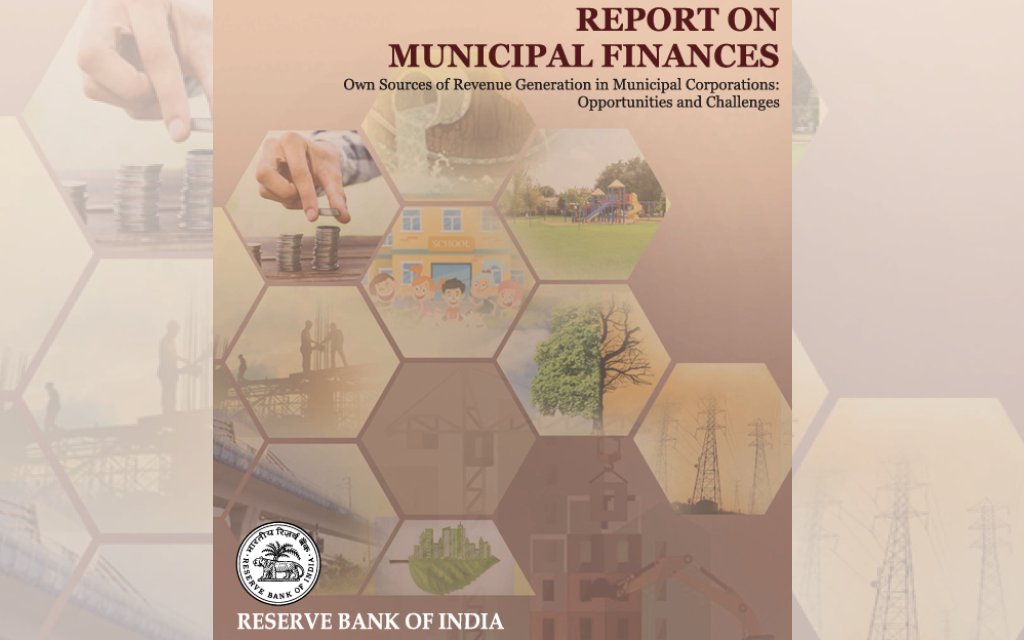
The latest RBI’s Report on Municipal Finances released on November 13, 2024, with the theme of “Own Sources of Revenue Generation in Municipal Corporations: Opportunities and Challenges” provides a first-of-a-kind analysis of the budgetary data for 232 municipal corporations (MCs), which covers more than 90% of total MCs in the country. The main findings are reproduced below:
- While the revenue account of the MCs has remained in surplus, their heavy reliance on transfers and grants from upper tiers of government continues.
- The own revenue sources are not adequate for meeting the revenue expenditure of most of the MCs, thereby affecting their functional and financial autonomy.
- Comprehensive reforms, including the adoption of technologies like GIS mapping and digital payments, rate rationalisation and their periodic revisions as well as better monitoring to plug leakages can help in the augmentation of their own source revenues.
Key statistics
The following are the key data reproduced from the report:
- MCs in Maharashtra, Gujarat, Karnataka, Madhya Pradesh, Haryana, and Telangana have surplus budget of above Rs.1,000 crore in 2023-24. MCs in Delhi, Andhra Pradesh, Rajasthan, Odisha, West Bengal, and Tamil Nadu have surplus budget of above Rs.100 crore. However, some MCs in Tripura, Jharkhand, Himachal Pradesh, Bihar, Chhattisgarh, Jammu and Kashmir, Uttar Pradesh, and Kerala have deficit budget, ranging from Rs.2 crore to over Rs.700 crore. Interestingly, Kerala, which is widely believed to have a strong local body system, has budgeted for a revenue deficit of Rs.789 crore for 2023-24.
- The revenues of MCs as a proportion of the revenues of the respective State governments vary widely. Delhi (34.5%), Maharashtra (14.1%), and Gujarat (7.8%).
- The revenue receipts of MCs amounted to 0.6% of GDP in 2023-24.
- Tax revenues are the largest source of revenue of the MCs (30%) followed by revenue grants, contributions, and subsidies (24.9%) and fees and user charges (20.2%).
- The ratio of MCs’ tax and non-tax revenue to the respective State government’s tax and non-tax revenue varied across States, indicating a vertical imbalance.
- Property taxes are a major source of own tax revenue of the MCs in India, constituting more than 16% of revenue receipts and more than 60% of their own tax revenue.
- The total expenditure of the MCs was at 1.3% of GDP. The revenue expenditure/GDP ratio hovered around 0.5 per cent of GDP, while the capital expenditure/ GDP ratio was 0.8%.
- The share of revenue expenditure in total expenditure was at 38.5%
- The proportion of capital expenditure in total expenditure for the MCs was 61.5% as compared with 24.8% and 21.4% for State governments and the Central government, respectively.
- The ratio of revenue expenditure to capital expenditure was 0.63 for the MCs as against 3.7 for the Centre and 3.0 for the States.
Status of MCs in Tamil Nadu
- By the end of the financial year 2023-24, Tamil Nadu had a total of 21 MCs, up from 15 MCs in 2020-21. By mid of 2024-25, the state has 25 MCs.
- The own tax ratio of MCs in Tamil Nadu was 44.3% as compared to the highest level at 53.8% in Karnataka and 50.3% in Telangana.
- The MCs in Tamil Nadu were able to maintain the ratio of capital expenditure with more than 50% in 2023-24 (BE) like in Maharashtra, Andhra Pradesh, Telangana, Jharkhand, Uttar Pradesh, Odisha, and Bihar.
- The per capita capital expenditure of the MCs in Maharashtra, Uttar Pradesh, and Tamil Nadu exceeded the All-India level (Rs.11,532/-) during 2023-24. However, per capita spending by MCs in Tamil Nadu was far behind the level of Maharashtra.
- The ratio of Revenue Expenditure to Capital Expenditure in 2023-24 (BE) for MCs in Tamil Nadu was below the All-India Level (0.63). Also, Own Source Revenue as a Ratio of Revenue Expenditure (Average of 2020-21 to 2022-23) in Tamil Nadu was below the All-India Level.
- MCs’ Tax revenues increased by 10.28% to 44.27% in 2023-24 from 33.99% in 2019-20. Revenue expenditures for operations and maintenance increased by 7.29% to 34.72% from 27.43% during the same period. Tables 1 and 2 show the details of the same.
|
Table.1: Revenue Receipts of Municipal Corporations in Tamil Nadu (Figures in %) |
|||||
|
|
2019-20 Accounts) |
2020-21 (Accounts) |
2021-2022 (Accounts) |
2022-23 (Revised Estimates) |
2023-24 (Budget Estimates) |
|
A. Tax Revenue |
33.99 |
31.13 |
34.26 |
45.61 |
44.27 |
|
B. Assigned Revenues & Compensations |
13.20 |
12.30 |
13.50 |
12.95 |
14.93 |
|
C. Rental Income from Municipal Properties |
4.62 |
3.16 |
3.69 |
2.24 |
2.75 |
|
D. Fees and User Charges |
13.04 |
11.82 |
14.35 |
10.86 |
11.52 |
|
E. Sale and Hire Charges |
0.69 |
0.90 |
0.29 |
0.17 |
0.10 |
|
F. Revenue Grants, Contributions and Subsidies |
26.29 |
33.09 |
26.41 |
23.54 |
21.68 |
|
G. Income from Investment |
4.11 |
4.03 |
3.49 |
1.95 |
1.62 |
|
H. Interest Earned on Loans |
0.93 |
0.84 |
1.14 |
0.66 |
0.53 |
|
I. Other Income |
3.14 |
2.73 |
2.87 |
2.01 |
2.59 |
|
Note: Figures calculated from the data of RBI Report, November 2024 |
|||||
|
Table.2: Revenue Expenditure of Municipal Corporations in Tamil Nadu (Figures in %) |
|||||
|
|
2019-20 Accounts) |
2020-21 (Accounts) |
2021-2022 (Accounts) |
2022-23 (Revised Estimates) |
2023-24 (Budget Estimates) |
|
A. Establishment Expenses |
51.33 |
46.85 |
48.70 |
46.25 |
45.15 |
|
B. Administrative Expenses |
5.55 |
6.84 |
3.30 |
7.72 |
8.18 |
|
C. Operational & Maintenance Expenses |
27.43 |
34.03 |
34.64 |
44.11 |
34.72 |
|
D. Interest and Finance Charges |
4.70 |
3.83 |
4.05 |
3.55 |
3.34 |
|
E. Programme Expenses |
0.24 |
0.89 |
1.24 |
0.76 |
0.35 |
|
F. Revenue Grants, Contributions and Subsidies |
3.72 |
1.72 |
2.15 |
0.51 |
1.16 |
|
G. Provisions and Write off |
2.47 |
1.75 |
2.19 |
2.39 |
2.30 |
|
H. Miscellaneous Expenses |
0.02 |
0.02 |
0.06 |
0.56 |
0.09 |
|
I. Depreciation |
28.64 |
32.00 |
28.99 |
4.76 |
3.74 |
|
J. Prior Period Item |
1.83 |
-1.21 |
-2.12 |
-1.09 |
-0.17 |
|
K. Transfer to Reserve Funds |
0.03 |
0.02 |
0.06 |
0.01 |
0.01 |
|
Note: Figures calculated from the data of RBI Report, November 2024 |
|||||
- Tables 3 and 4 provide the status of capital receipts and expenditures of MCs in Tamil Nadu for the last five years from 2019-20 to 2023-24. The Union Finance Commission’s contributions to MCs in Tamil Nadu have increased by 6.72% to 14.41% in 2023-24 from 7.69% in 2019-20. However, the State Finance Commission’s contributions to MCs increased by 17.04% to 54.62% from 37.58%. The Secured loans of MCs increased by 4.55% to 12.74% in 2023-24 from 8.19% in 2019-20.
|
Table.3: Capital Receipts of Municipal Corporationsin Tamil Nadu(Figures in %) |
|||||
|
|
2019-20 Accounts) |
2020-21 (Accounts) |
2021-2022 (Accounts) |
2022-23 (Revised Estimates) |
2023-24 (Budget Estimates) |
|
A. Grants, |
76.11 |
77.79 |
77.15 |
76.79 |
77.01 |
|
Of which: Finance |
7.69 |
7.73 |
1.68 |
9.48 |
14.41 |
|
Of which: Central |
17.58 |
13.93 |
9.34 |
15.22 |
17.16 |
|
Of which: State Finance |
1.32 |
3.34 |
0.22 |
0.95 |
0.91 |
|
Of which: State |
37.58 |
37.92 |
44.77 |
54.56 |
54.62 |
|
Others |
35.84 |
37.08 |
43.99 |
19.79 |
12.90 |
|
B. Secured Loans |
8.19 |
8.52 |
6.81 |
8.88 |
12.74 |
|
C. Unsecured Loans |
0.31 |
0.47 |
0.57 |
0.63 |
0.63 |
|
D. Deposits Received |
3.43 |
3.98 |
3.97 |
3.62 |
5.19 |
|
E. Deposit Works |
0.00 |
0.00 |
0.00 |
0.00 |
0.00 |
|
F. Other Liabilities |
11.96 |
9.24 |
11.49 |
10.08 |
4.43 |
|
Note: Figures calculated from the data of RBI Report, November 2024 |
|||||
|
Table.4: Capital Expenditure of MunicipalCorporations in Tamil Nadu(Figures in %) |
|||||
|
|
2019-20 |
2020-21 |
2021-2022 |
2022-23 |
2023-24 |
|
Accounts) |
(Accounts) |
(Accounts) |
(Revised Estimates) |
(Budget Estimates) |
|
|
A. Fixed Assets |
52.26 |
47.15 |
42.59 |
40.67 |
50.96 |
|
B. Capital |
29.58 |
36.68 |
42.13 |
51.90 |
38.71 |
|
C. Investments – |
3.79 |
4.04 |
4.19 |
4.58 |
3.79 |
|
D. Investments – Other |
0.50 |
0.36 |
0.38 |
0.83 |
0.69 |
|
E. Stock-in-hand |
0.08 |
0.09 |
0.09 |
0.03 |
0.03 |
|
F. Pre-paid Expenses |
2.31 |
4.73 |
3.91 |
0.00 |
0.02 |
|
G. Loans, Advances and |
2.69 |
2.56 |
3.28 |
0.95 |
0.84 |
|
H. Other Assets |
8.79 |
4.38 |
3.44 |
1.04 |
4.97 |
|
Note: Figures calculated from the dataof RBI Report, November 2024 |
|||||
Conclusion
The report concludes that the financial capacity of municipal corporations “remains limited, hampering their ability to provide essential services and drive urban development effectively.” Further, their dependence on the Centre & the State funds curtails their “financial autonomy and capacity to plan and execute long-term projects.” It summarizes that “amidst the growing pace of urbanisation, and the rising demand for more efficient public services, the responsibilities of municipal corporations (MCs) are expanding fast. With urban areas emerging as key engines of growth, the administrative and financial capacities of city authorities need continuous augmentation to meet public aspirations.”
For a long time, many States including developed ones have not consistently and adequately undertaken efforts to promote institutional reforms for empowering municipal corporations. It is time to plan and act to ensure local bodies, especially the urban bodies are adequately reformed to ensure they become the engines of growth for the States and the nation.
B.Chandrasekaran is the Chairman of the AgaPuram Policy Research Centre, Erode.
Views expressed by the author are personal and need not reflect or represent the views of the AgaPuram Policy Research Centre.