Chandrasekaran Balakrishnan

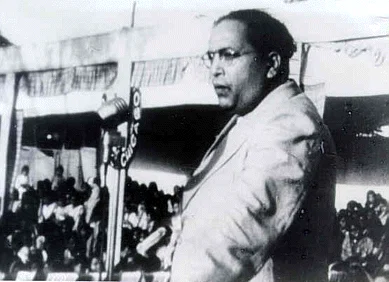
B.R.Ambedkar, the Greatest Free Market Economist of India

B.R.Ambedkar, the Greatest Free Market Economist of India B.R.Ambedkar, the Greatest Free Market Economist of India Chandrasekaran Balakrishnan January 23, 2014 Indian Liberals Before Ambedkar became a lawyer, social reformer and Constitution maker, he was a professional economist. Strangely, he is now known more as a Dalit leader than as an economist in the Dalit community as well as in the society at large. Socialist myth: when people do talk about his economics, but it is about his opposition to capitalism and socialist leanings. This is a myth forwarded by dalits to further their own agenda.In fact, Ambedkar did not oppose free-markets but was himself an advocate of free-markets!! Dalit politics: his economics is ignored by the mainstream and misrepresented by the dalits community because it is contrary to the socialist politics in India. True free-market capitalist: those who know about his economics downplay it but he was free-market economist even before Austrian Economists like F.A.Hayek, etc. Significance of Ambedkar’s economics today: in the heyday of economic reforms in India, we need to rediscover the Ambedkar’s economics, especially his ideas of free-market principles, to empower the dalits and raise them from deep ignorance. In his article “Dalit Capitalism and Pseudo Dalitism” (5 March 2011, pp 10–11), the civil rights activist Anand Teltumbde makes several dubious claims, one of them being Ambedkar’s opposition to capitalism/free market economics “throughout his life”. In reality, Ambedkar was one of the first-generation economists in India and a leading free-market economist in the early decades of 20th century. He was a trained economist with degrees from Columbia University in U.S.A and the London School of Economics before moving on to law and social theory and practices. The reason for this myth is the poor understanding of the intellectuals among the Dalit community and by the mainstream academia and society. The academic environment both in India and abroad has almost forgotten Ambedkar as an economist (leave alone his contribution to free-market economics). According to eminent economist Narendra Jadhav, the lack of awareness continues due to the “intellectual slavery of the Indian society”. Even today, there is a blatant lack of awareness about Ambedkar’s life and works. We continue to underestimate, or worse ignore, the many original contributions that Ambedkar made to many mainstream economics theories in the latter part of the 20th century. Professor S. Ambirajan (1999:3280) said, “I am somewhat distressed to see that he is portrayed as a leader of the ‘dalit’ community and nothing else.” Dalit activists such as Teltumbde seem to downplay Ambedkar’s free-market economics. For example, Teltumbde says: The protagonists of globalisation have tried to project him as a proponent of the free-market, indeed, as a neoliberal, and have even gone to the extent of painting him as a monetarist (monetarists are supposed to be the intellectual initiators of neoliberalism) to claim him in support of their propaganda. In any case, how many dalits, even among the educated ones, know what monetarism is?  Further, Teltumbde paints Ambedkar as a socialist and Marxist: Ambedkar, who publicly professed his opposition to capitalism throughout his life, was thus willfully distorted to be the supporter of neoliberal capitalism, which globalisation is! This denial of Ambedkar’s free-market credentials seems to be rooted in further propagating Ambedkar’s socialist beliefs for populist reasons and political gain, which is a gross mistake and a misrepresentation of his original arguments. Indeed:  [Ambedkar] rejected the totalitarian approach of Marx in advocating control of all the means of production. He did not accept the Marxian position that the abolition of private ownership of property would bring an end to the poverty and suffering of the have nots. He also did not accept the Marxian prognosis that the state is a temporary institution that will wither away in course of time. (Jadhav, 1991: 982). In fact, in his book States and Minorities, Ambedkar entrusted: …an obligation on the state to plan the economic life of the people on line which would lead to highest point of productivity without closing every avenue to private enterprise, and also provide for equitable distribution ofwealth (ibid 982). To illustrate my core contention that Ambedkar was a free-market economist, I would like to draw the reader’s attention to his early career as a professional economist. Ambedkar wrote at least three scholarly contributions to economics and in which he makes many original arguments. (1) Administration and Finance of the East India Company (1915) (2) The Problem of the Rupee: Its Origin and Its Solution (1923, and (3) The Evolution of Provincial Finance in British India: A Study in the Provincial Decentralisation of Imperial Finance (1925). The Problem of the Rupee was Ambedkar’s magnum opus and was based on his LSE thesis. He emphasized the need for a sound monetary system for trade and its nexus with private property rights, writing in the first chapter (1947: 1-2): Trade is an important apparatus in a society, based on private property and pursuit of individual gain; without it, it would be difficult for its members to distribute the specialized products of their labour. Surely a lottery or an administrative device would be incompatible with its nature. Indeed, if it is to preserve its character, the only mode for the necessary distribution of the products of separate industry is that of private trading. But a trading society is unavoidably a pecuniary society, a society which of necessity carries on its transactions in terms of money. In fact, the distribution is not primarily an exchange of products against products, but products against money. In such a society, money therefore necessarily becomes the pivot on which everything revolves. With money as the focusing-point of all human efforts, interests, desires, and ambitions, a trading society is bound to function in a regime of price, where successes and failures are results of nice calculations of price-outlay as against price-product. He further went on to say: Money is not only necessary to facilitate trade by obviating the difficulties of barter, but is also necessary to sustain production by permitting specialization. For, who would care to specialize if he could not trade his products for those of others which he wanted?

B.R.Ambedkar, the Greatest Free Market Economist of India Read More »

State-Democracy-and-Development-Institutional-Perspectives

Democracy and Development Democracy and Development Chandrasekaran Balakrishnan August 23, 2013 Democracy and Institutions The evolution of any civilisation depends on the formations and functioning of its institutional systems, the interplay of which allows the constituents of the society to pursue prosperity and happiness. The nature of these institutional systems and structures provide the fountainhead for ideas like democracy to germinate and flourish. However, as witnessed all over the world especially after the World War-II, preaching and eulogising about democracy as the ideal political system is much easier than practising and adopting it with all its limitations-political and otherwise. Most of the nations practise democracy in some form or the other and the differences exist only in the scale, times and methods employed. As the basic principles of democracy remain intact, the key question that emerges is which nation practices the most involved kind of democracy? In other words, in which nation has democracy attained its highest maturity? The answer would be relative and not absolute, as democracy like any other virtue would have a never-ending kind of perfection or maturity to be attained. The ingredients that make a nation democratic are so diverse and complex that the process or art of perfecting democracy would always be a work-in-progress. The nature of inclusive institutional systems, degree of economic and political freedom could always be refined and taken to the next level, where the benefits out of such evolution would be, at least, marginally higher than its previous level. The United States of America, which attained Independence way back in 1776, is believed to be having the most-evolved form of democracy. Comparatively, the World’s largest democracy, India has a system that is not as perfect or as evolved as the US. The U.S has a better and more inclusive democratic structure than India. This may be attributed to the high degree of political and economic freedom the US citizens enjoy compared to India, where citizens at best enjoy better political freedom than economic freedom. Nevertheless, both the nations may have to consider their respective democratic set-up as one that could still be substantially improved upon. While countries like the US could continue to work on the political, social and economic elements of democracy, nations like India would have to work on all the three main elements of democracy. The constitution of a country is the foundation for establishing the guiding principles for its inclusive institutional framework, which determines the endeavour of its citizens. As many nations have drafted their constitution based on the basic human values and principles practiced in other nations, inclusiveness has to be a definite outcome of a constitution. However, factors like ethos, history, cultural values of each nation also substantially decide the character of a nation. It is these basic yet significant elements that determine the nature, quality and direction of the democratic system practised in a nation. Making Democracy Work Better in India India, like other democracies, has come a long way during the last 65 years to make its democracy more inclusive. Unlike some of other nations, India has a strongly worded, well written and longest constitution in the world. As Dr.Pratap Bhanu Mehta rightly says that “the Indian constitution was self-consciously anti-revolutionary. This is manifest in all the debates in the Constituent Assembly at that time; its members knew very well that change would be slow and gradual. The political culture was one of democratic argument and decision-making based on consensus, initially embodied in the structure of the….practices of coalition politics”. Though the achievements in practising and perfecting democracy in India in the last 65 years may seem to be less satisfactory, the achievements in the three main spheres of democracy are worth cherishing. Improvements in the quality of freedom in the political and economic elements of the nation are considerable during this period. In a way, the relative success of Indian democracy is amazing considering the orderly interaction of the seemingly disorderly components of its society, polity and economy, primarily due to its cultural, linguistic and traditional complexities and diversities. Noted Indian historian Dr. Ramachandra Guha in his famous book “India After Gandhi: The History of the World’s Largest Democracy” describes at least five social forces which are of pre-eminence in the social landscape of contemporary India after Independence. All these complex elements of class, religion, language, caste and gender are highly interdependent and the interplay of these factors shapes the society and its democratic institutions. According to Dr. Guha, “contemporary India is a democracy based on adult suffrage, with a free press and a largely independent judiciary. At no other time or place in human history have social conflicts been so richly diverse, so vigorously articulated, so eloquently manifest in art and literature, or addressed with such directness by the political system and the media”. Besides these social elements, there are also other economic and political elements that eventually guide the formation and functioning of the institutional structure and systems of the democracy. The differences and incompatibilities between these elements create the intricacies and shortfalls in the constitutionally created democratic institutions, which determine the quality and extent of democracy that prevails in the country. Further, Dr. Guha goes on to say that “democracy in India will turn out to be ‘more significant’ than comparable experiments in West”. This kind of optimism and faith is based on the strength of some of the successful and independent democratic institutions like the Supreme Court, Election Commission, Comptroller and Auditor General, etc. According to Professor Ashima Goyal, “India started out with highly inclusive political institutions since it adopted democracy with universal suffrage at independence. But extractive economic institutions, inherited from the British, were made more so by economic controls.” It is because of the control raj in economic domain especially during the period 1966-1977, that the Western pundits painted a gloomy picture about democracy in India. As always in the past, Indian history disproved them once again. Indeed, the experiments with democracy in India have

State-Democracy-and-Development-Institutional-Perspectives Read More »

Pseudo-liberals-and-neo-colonisers

Pseudo – Liberals and Neo – Colonisers Pseudo – Liberals and Neo – Colonisers Chandrasekaran Balakrishnan December 23, 2012 Indian Liberals I was recently accused of being a pseudo feminist. Here’s why. While talking on the Sabarimala issue, I said, women who are ready to wait were not anti-feminist, but merely were respecting tradition. A colleague of mine rightly countered me by pointing out how I had made my feelings against triple talaq heard. It really got me thinking. While justifying the need for religious traditions to coexist in a democracy, I might proudly wear the badge of being a liberal. By openly critiquing Mahatma Gandhi and by opposing to Veer Savarkar’s ideology, a section of today’s voters call themselves moderates.But in reality, who are we, if not pseudo liberals or pseudo feminists? In the age of Modi-Trump-Johnson politics (all right-leaning leaders belonging to conservative parties), it definitely feels like the right thing to do, to raise our voice of dissent, of disgruntlement towards the government. The Modi government wants to confer Bharat Ratna on Veer Savarkar? Lets list all the Hindu-oriented ideologies he preached or let’s recall how he justified use of rape as a weapon of war.Article 370 abrogated? Let’s raise voices without considering what people in the state actually want. When a BJP leader urges people to buy swords, while awaiting verdict on the Ayodhya case we cringe; suggest that the land be divided equally and let there be a mosque as well as a temple erected on it. To be honest, I was raised in a household that was proud to be Hindu and did not have high opinions about those belonging to other religions. I was asked not to walk through the ‘Muslim galli’ especially after dark. My husband grew up in Kerala and has some egalitarian ideologies instilled. At least he and his family have no ill feelings or prejudice against people belonging to other religions or other castes. So maybe my thoughts evolved with time and while I am actually a modern feminist who believes in equality and the idea of coexistence, going by my grooming I should be an adarsh nari who is pro BJP? Instead, why can’t I be a moderate. Scores of those belonging to my generation or born between the late 70s and late 80s are surely at a juncture when they are questioning their values. On my last trip to Mumbai, I met with two groups of friends. One, a bunch of women I grew up with, all of them doing quite well career-wise, have a healthy work-family balance, in the thirties. Most of them (to my astonishment) were pro the BJP government. They proudly parroted the economic benefits their beloved Modi sarkaar brought about including lowering corruption (in perceived corruption in the public sector in 2018, India is 78th among 180 countries compared to 85 among 175 countries in the 2014).The other group, the bunch I went to college with, most of them single, living in prime residential areas between Juhu and Bandra, were unhappy with the government, bashed it on numerous issues that affected them locally like potholes that inconvenienced commute and the Aarey issue, drainage problems and more. Personally, I would like to identify myself with the second bunch. Nope, not because they seem the ‘cooler’, ‘more intellectual’ type. Because they seem like a voice of reason and not one derived from emotion. They were talking of everyday issues faced by everyday people, rather than of the parallel changes that make us look good on a macro level— confused? Don’t be. Democracy should not be catering to a single stratum of a society. It should benefit people from all classes. Drainage problems should be resolved so that the homeless who sleep on the street, the stray dogs, the cattle don’t get swept away and thousands of lives aren’t lost. Not just because water causes damage to cars and other vehicles of middle class/ upper middle class families. On the other hand, economic and sustainable housing should be made available to those who cannot afford it so that people aren’t living on the streets in the first place. While, swamps should not be reclaimed nor should trees be cut down illegally to accommodate them, as it could prove to be harmful to the environment and cause the flooding that we want to avoid — makes sense? I hope so!Coming back to my question. Why can’t we belong to a generation who oppose triple talaq, a practice where women have very little or no say, while not agreeing with the Sabarimala verdict because that does not further women’s equality in anyway. Here is to the moderates! Facebook Instagram X-twitter

Pseudo-liberals-and-neo-colonisers Read More »

A-liberal-vision-for-india

A liberal Vision for India A liberal Vision for India Indian Economy February 23, 2012 Chandrasekaran Balakrishnan  In 2011, India made a distinct turn away from economic freedom with the failure of FDI in retail and the Cabinet nod for the so-called Food Security Bill—‘food’ for none, job ‘security’ for babus and a ‘bill’ for the rest of us. This turn towards statism will not be without terrible consequences. In spite of the two decades of progress brought about by a marginal increase in economic freedom, India has lost the plot. The question is why. At least in part it is because economic freedom is not, and was not even in 1991, defended as a matter of principle. To defend opening up of the retail sector to foreign investors or doing away with import duties on used cars as singular measures is playing in socialist terrain, for those against liberty will point to specific gains from curtailing freedoms while promoters of freedom have only yet unknown gains to offer. There is an urgent need to change the very terrain of public policy debate in India, and we must begin by paying heed to the following passage from Nobel Prize winner, F A Hayek’s book The Constitution of Liberty: “…freedom is almost certain to be destroyed by piecemeal encroachments. For in each particular instance it will be possible to promise concrete and tangible advantages as a result of curtailment of freedom, while the benefits sacrificed will in their nature always be unknown and uncertain. If freedom were not treated as the supreme principal, the fact that the promises which a free society has to offer can always be only chances and not certainties, only opportunities and not definite gifts to particular individuals, would inevitably prove a fatal weakness and lead to its slow erosion”. And a defence of liberty as a principle ought to offer a vision for India—a vision with answers to three fundamental questions. One, how can India become rich? Two, what about income-inequality? And three, what about the caste-system? We look at each in turn. One, how can India become rich? Modern economic growth happens through widespread application of science to production processes. And this happens not by government intervention but by entrepreneurship. Simon Kuznets, who won the Nobel Prize in 1971, tells us that “many economically important inventions of the late nineteenth and early twentieth centuries were the results of attempts to apply new scientific discoveries, attempts by people like Edison and Marconi who were no scientists but who understood the scientific advances and were impelled to look for practical applications”. The Soviet Union despite having had a very high number of PhDs per capita at one point did not produce a single innovation in consumer goods! This is because entrepreneurs bloom only in free market economies. Economists James D. Gwartney, Randall G. Holcombe, and Robert A. Lawson in a cross-country study of 99 countries for the period 1980-2000 find that “holding constant geographic factors and changes in human and physical capital, a one-unit increase in a country’s EFW [an index of economic freedom] rating increases the growth of per capita GDP by about 1.24 percentage points.” And 1.24 is not a small number; with the magic of compound interest a two unit increase in EFW could by itself double incomes in 29 years. In short, both theory and history tell us that the only – and yes only – way ordinary Indians can become wealthy is through a market economy. Two, what about income distribution? The market process is a leveling process both on the production and consumption side. A characteristic feature of a laissez faire economy is the introduction of new products and new production methods. This means capital employed in old production methods continuously become obsolete, and the wealth of owners of that capital depreciates in value. New entrepreneurs rise to riches and old fall, Vilfredo Pareto called this the “circulation of elites”. The elite in capitalism (unlike in Feudalism or Communism) are like the occupants of a hotel, the hotel is always full but never of the same people! That is the story on the production side. As for the consumption side, suffice it to quote the great Joseph Schumpeter: “the capitalist achievement does not typically consist in providing more silk stockings for the queen but in bringing them within the reach of factory girls…” The vast majority of government redistribution plans appear pale in contrast to the capitalist redistributive process. And redistribution through profit- motive rewards success in serving others unlike redistribution through vote-motive which reflects success in stealing from others. Lastly, what about the caste system? Capitalism nailed feudalism in the Western Europe, and it promises to do far worse to the caste system in India. Kuznets tells us that “Amongst the concomitants of modern economic growth are…an increase in the non-personal forms of economic organisation, and a rise in the relative important of economic achievement in the scale of social values”. Non-personal forms of economic organisation—no city dweller knows the caste of her milk producer—limits the domain of discrimination. And the growing influence of economic achievement flies in the face of by- birth social values. Interesting fairly modest increases in economic freedom seems to have brought above significant improvements for Dalits in India. In a 2011 paper, University of British Columbia scholars Hnatkovska, Lahiri and Paul find that wage gaps between Scheduled Castes (people from the bottom rung of the Hindu caste system) and non- Scheduled Castes have declined since the 1980s. This is no surprise, profit seeking firms link wages to worker productivity, not caste! Progress however is not merely an income- story. A recent survey of 19,087 Dalit families in two districts of Uttar Pradesh found that access to markets had improved Dalit grooming and eating practices, and increased access to jobs traditionally considered to be non-Dalit. In short, a market economy is the antidote to the age old caste system. And unlike the government’s lets-enlighten-the- masses

A-liberal-vision-for-india Read More »

India-should-re-wrap-economic-reforms

India should Re-Wrap Economic Reforms India should Re-Wrap Economic Reforms Chandrasekaran Balakrishnan February 3, 2012 Economic Reforms   I do not minimise the difficulties that lie ahead on the long and arduous journey on which we have embarked. But as Victor Hugo once said, “no power on earth can stop an idea whose time has come”. I suggest to this august House that the emergence of India as a major economic power in the world happens to be one such idea. Let the whole world hear it loud and clear. India is now wide awake. We shall prevail. We shall overcome. — Manmohan Singh, finance minister, Budget Speech, July 24, 1991 In the two decades since Manmohan Singh’s hat-tip to Victor Hugo, and open markets, per capita income in India has grown from $309 to $1,477 (in today’s dollars), outstripping that of 19th century US and 20th century Japan. Life expectancy at birth grew by seven years, infant mortality rate fell by 40 percent and wage inequality between scheduled caste and other workers declined during the same period. Caste-based differences in grooming, eating and occupation narrowed as more open markets allowed a greater number of people to access a wide range of consumables and services. Yet, despite these lofty successes of the 1991 reforms, pro-market policies are viewed with deep suspicion and antipathy in India.The reason for that perhaps lies in the way reforms were thrust on the country. A 2008 paper by Peter Boettke, Christopher Coyne and Peter Leeson titled ‘Institutional Stickiness and the New Development Economics’ has an explanation that could fit India. The economists theorised that big institutional changes should be rooted in existing cultures, customs and belief systems of a nation to succeed. They called it métis. Métis is a set of informal practices and expectations that allow ethnic groups to build successful trade networks. The diamond trade in New York City, for instance, is dominated by orthodox Jews who use a set of signals, cues, and bonding mechanisms evolved over centuries for trading. The trade would not function as smoothly if random traders were placed in the same setting. This difference can be ascribed to métis. Because it is based in the accepted, understood, and habituated mentalities and practices of indigenous peoples, the presence or absence of métis explains the stickiness of various types of institutions. In fact, métis can be imagined as the glue that gives institutions their stickiness.A large portion of the Japanese métis, which was harmonious with large-scale organisations, trade and market exchange, remained intact in the post-war period, helping in its successful reconstruction. While the Japanese adopted a constitution affirming their commitment to Western democratic institutions, much of the language expressed pre-World War II traditional Japanese social and political values.Why did India fail to do this? The reasons are embedded in what and who influenced post-Independence India’s politics and economic thinking. The foremost perhaps is the Nehru-Gandhi family’s socialist bent. Socialism took India from one of the first developing countries to manufacture automobiles in the 1930s to one whose primary export was communicable diseases by 1991. No member of the Congress party dares say Nehru or Indira Gandhi got it wrong because the Indian métis is incompatible with socialism, even when moving away from it. Manmohan Singh began his July 24, 1991, Budget speech by saying how he was “overpowered by a strange feeling of loneliness” because Rajiv Gandhi was no more. He went on to say, “thanks to the efforts of Pandit Jawaharlal Nehru, Indira Gandhi and Rajiv Gandhi, we have developed a well-diversified industrial structure.” Forty years of socialism meant that India produced political parties which excelled in winning elections in a socialist economy! Winning elections meant selling ‘collectivist’ ideas that were alien in an India métis. Market reforms in India remain a set of ‘dry economic ideas’ because there are few with the experience of selling these as ‘political ideas’. The reformers were unable to convince even the intellectual elites in influential economic institutions and learning centres. That meant the premier institutions dedicated to studying economics and Indian society did not believe in reforms, at least initially.It has had its natural consequences. Not only did economic reforms sell poorly, the new policies edged out—instead of integrating and modernising— traditional economic institutions and practices like badla (stock market lending mechanism), hawala (a much-maligned, but low-cost and efficient money transfer mechanism), and rural moneylenders.  It is time India expresses economic freedom through its own social values—not as a tool, but as a value in itself. Economic freedom ought to be seen as a pre-requisite to benefitting from a rich tradition of business and entrepreneurship inherent in India’s diversity. Various communities have showed sharp business acumen, innovation and entrepreneurial skills. Indian managers are prized assets even on Wall Street. The Sikhs, Jains, Marwaris and Parsis have demonstrated their skills in building world-class businesses. The idea of economic freedom must also be explained through the thoughts of influential Indian intellectuals. It is no secret that B.R. Ambedkar’s economic beliefs tilted towards Adam Smith rather than Karl Marx. Freedom fighter and India’s second home minister C. Rajagopalachari went even further. “A free market…will result in expansion of industry and rise in employment,” he wrote in 1958. Rajaji, as he was widely known, believed that political freedom could not survive unless it was sustained by economic freedom.  The idea of economic freedom is not new to India. The challenge for reformists in India is to promote elements of the Indian métis that are in harmony with a free market economic outlook. In short, the way in which economic reforms are presented matters. Vipin P. Veetil is doing his Ph.D in economics from Iowa State University. B. Chandrasekaran works in public policy in New Delhi. Facebook Instagram X-twitter

India-should-re-wrap-economic-reforms Read More »

20 years since India’s economic reforms

20 years since India’s economic reforms 20 years since India’s economic reforms Chandrasekaran Balakrishnan November 28, 2011 Economic Reforms India in the last 20 years has started to reverse the Keynesian-inspired planning that clouded its growth since independence.  A large part of this turnaround was driven by one of Hayek’s students at the LSE, B R Shenoy, whose ideas are now coming into fashion. It is interesting that as the West once more embraces the Keynesian policy options, the East is rejecting it. This article in honour of Prof Shenoy was co-authored with B Chandrasekaran. “An Indian will, on average, be twice as well off as his grandfather; a Korean 32 times” said Robert Lucas in a 1985 paper titled On the Mechanics of Economic Development. The Nobel laureate’s figures were based on the 1960-1980 period when India’s per capita income grew at 1.4% per year. In the period from 1992-2002, India’s per capita income grew at 3.7%, and from 2003 to 2010 it grew 6.9% – at this rate an Indian too will be 32 times better off than his grandfather. August 2011 marks two decades since a high level committee—Narasimham Committee—was setup by government of India to initiate financial sector reforms. The deregulation recommendation by the Narasimham Committee went a long way in improving capital market efficiency – a key ingredient of economic growth. Ideas of free market economics, however, were not new to India. Long before 1991, Prof B R Shenoy had fought a lonely battle to promote free-exchange. Shenoy warned India about the consequences of “central planning” twenty years before Jagdish Bhagwati and T N Srinivasan told us – in their 1975 book Foreign Trade Regimes and Economic Development: India – “that India’s foreign trade regime, in conjunction with domestic licensing policies in the industrial sector… impaired her economic performance”. Shenoy was the only Indian economist to write a Note of Dissent to the 2nd Nehru-Mahalanobis Five Year Plan (similar to the Soviet Gosplan). In the 1955 Note, Shenoy points out that the 2nd Plan “begins by prescribing the increase in national income which the Plan would set to achieve”.  In other words, the plan begins with a certain growth rate and then goes about figuring out how to gather necessary savings. Shenoy says “the availability of real resources must be assessed first and the investment plan must match it”. This was at a time when Joan Robinson’s view that “It is the rate of investment which governs the rate of saving, and not vice versa” was in fashion. The government of India and its economic advisors choose to reject Shenoy’s wise remarks. What followed was an unfortunate verification of Shenoy’s theoretical vision. The average per capita income growth for the first five 5-year plan periods was a meager 1.5%. Joseph Schumpeter in his 1910 essay on Leon Walras says “It has become long since manifest who was being judged when the Academie des Sciences Morales et Politiques rejected his work”.  Perhaps the same can be said of the government of India’s rejection of Shenoy. “Is there some action a government of India could take that would lead the Indian economy to grow like Indonesia’s or Egypt’s?” asked Robert Lucas in the mid 80s. In 1991 the government of India took some such actions. And the debate turned ideological, especially with the IMF’s condition-ridden package. Shenoy was the first economist of independent India to lucidly support free-market policies: Efficient management of business and industrial concerns in a competitive market economy is a highly specialised function…best left to private entrepreneurs. The reforms were greeted with skepticism at best and outright rejection at worst amongst India’s intellectual class. Arun Ghosh—in an August 1992 Economic and Political Weekly article titled One Year of Narasimha Rao Government: A Balance Sheet—declared “The Narasimha Rao government’s economic policies have not brought any promise of harmony and progress to the Indian economy.” Rather symbolically, the article was on the same page as an advertisement for the Hindi translation of a book titled The Russian Revolution by Rosa Luxemburg. Surprisingly, in the midst of the ideological battle of early 90s, Shenoy’s ideas were not resurrected for intellectual support. S B Mehta wrote in 2001 of  events a decade earlier: the then Finance Minister was criticized by many that we were mortgaging our sovereignty to IMF. This author wrote to him that he should declare that we were following the policy that Shenoy hinted for twenty long years…. No politician or economist, however, uttered the name of Shenoy… Thus, it seems, we neglected the sound advice of Shenoy during his life-time [and also] when our policies leaned more towards free market. With his 1931 article in the Quarterly Journal of Economics, Shenoy became the first Indian economist to publish in leading scholarly journal. However, Shenoy is not just a scholar of the past; his ideas are of great relevance today.  Take the debate on corruption, for instance. In February 1975, Shenoy delivered a lecture in Ahmedabad putting forward the thesis that interventionism is the root cause of corruption. And data backs his claim: Transparency International’s perception of corruption index and Heritage Foundation’s economic freedom index are strongly correlated. The 10 least corrupt countries have an average economic freedom index rank of 11, while the average for 10 most corrupt countries is 163! Shenoy choose to be “right in a minority of one”. As India marks two decades of economic reforms, it is time classical liberals come forward to institutionalize B R Shenoy’s ideas. They say that VKRK Rao, a prominent post-independence Indian economist, “strode like a Colossus over the Social Science disciplines”. He established four institutions: the Delhi School of Economics, the Institute of Economic Growth, the Indian Council of Social Science Research, and the Institute for Social and Economic Change. Shenoy established none. The difference was at least partly because of their respective economic views. Rao was awarded his PhD in 1937 from Cambridge and was a student of Keynes. Shenoy was from the London School of Economics and was highly influenced

20 years since India’s economic reforms Read More »

B-R-shenoys-forgotten-voice-of-dissent

B.R.Shenoy’s Forgotten Voice of Dissent B.R.Shenoy’s Forgotten Voice of Dissent Chandrasekaran Balakrishnan July 29, 2011 Indian Liberals On a pleasant   March day in 1963, Milton Friedman met US Ambassador J. K. Galbraith for lunch in New Delhi. The invitation from Galbraith read, “As you know, I do not agree with your ideas, but they will do less harm in India than anywhere else…” Even Galbraith — a great proponent of planning — recognised the relation between corruption and interventionism. Unfortunately, a great majority of India’s economists toed the Gosplan line. (Gosplan is short for Russia’s state committee for planning whose Five Year Plans continue to be a model for India.)  B.R. Shenoy is the only Indian economist to write a note of dissent to the second Five Year Plan. Shenoy, India’s first monetary economist, thought that “the only hope of eradication of corruption on the current scale is a complete U-turn in our policies”. An ombudsman will not solve the problen of corruption in the world’s 10th largest economy, only more business freedom will. In February 1975, Shenoy delivered a lecture in Ahmedabad putting forward the thesis that interventionism is the root cause of corruption. Shenoy says corrupt payments arise because “a piece of paper which costs nothing, but the signature of the government official concerned to produce” has value. And it has value because government policy mandates acquiring licences, permits and quotas (LPQ) to run businesses. Data backs Shenoy’s theoretical ideas. There is a strong empirical relation between Heritage Foundation’s measure of ‘business freedom’ and Transparency International’s corruption index. In 2010, seven of the world’s 10 ‘least corrupt’ countries ranked amongst top 10 in ‘business freedom’: New Zealand, Singapore, Denmark, Canada, Sweden, Finland and Iceland. The 10 most corrupt countries have an average business freedom rank of 154, the 10 least have a rank of 12. India’s business freedom rank is 167!The Nordic countries from whom the concept of Ombudsman is borrowed, have an average ‘business freedom’ rank of 8. These countries do not have LPQ levers which bureaucrats could use to extract rents. According to the Swedish Parliamentary Ombudsmen Report for 2007-08, only one case ended in “prosecution and disciplinary proceedings”. The Ombudsman does fine-tune a well functioning system; it cannot fix a broken system like India. Unfortunately, the great Indian corruption debate is a battle between two camps of interventionists: Neither the government nor Team Anna realise that corruption is a consequence of entrusting few ‘wise’ men with too much, more of the same will not solve the problem. Shenoy, with his 1931 Quarterly Journal of Economics article, became the first Indian economist to publish in an academic economics journal. But India chose to ignore his critique of central planning. What followed was a tragic verification of his theoretical vision.   (Vipin P. Veetil is doing his Ph.D. in Economics at Iowa State University. B. Chandrasekaran is in the Planning Commission, New Delhi) Facebook Instagram X-twitter

B-R-shenoys-forgotten-voice-of-dissent Read More »

Gandhi-the-liberal

Gandhi,the Liberal Gandhi,the Liberal Chandrasekaran Balakrishnan July 23, 2011 Indian Liberals  Are Gandhian economic policies incompatible with free market economics? Gandhi advocated limited government intervention, unfettered individual liberty and freedom, higher education in private hands and sex education in schools. In the wake of the global economic crisis, it is pertinent to examine Gandhi’s views on economics and ethics. Writing in Young India (1921), Gandhi argues: “I do not draw a sharp or any distinction between economics and ethics.Economics that hurt the moral wellbeing of an individual or a nation are immoral and, therefore, sinful. Thus the economics that permit one country to prey upon another are immoral…The economics that disregard moral and sentimental considerations are like wax works that, being life-like, still lack the life of the living flesh. At every crucial moment thus new-fangled economic laws have broken down in practice. And nations or individuals who accept them as guiding maxims must perish.”This is akin to what Adam Smith emphasised in his first book, The Theory of Moral Sentiments, in which he coined the phrase‘invisible hand’. Gandhi, as a philosopher of human action, seems to be well aware of the consequences of the moral sentiments.Advocating individual freedom and liberty, Gandhi wrote in the Harijan (1943 & 1942): “If individual liberty goes, then surely all is lost, for if the individual ceases to count, what is left of society? ….No society can possibly be built on a denial of individual freedom. It is contrary to the very nature of man”. Further he went on to argue that “Every individual must have the fullest liberty to use his talents…Individual liberty and inter-dependence are both essential for life in society.” Indeed, there is some convergence between Gandhi and Ambedkar on their views on the individual and society. Ambedkar argued that: “Unlike a drop of water which loses itsidentity when it joins the ocean, man does not lose his being in the society in which he lives. Man’s life is independent. He is born not for the development of the society alone, but for the development of his self…The first is that the individual is an end in him self and that the aim and object of society is the growth of the individual and the development of his personality. Society is not above the individual and if the individual has to subordinate himself to society,it is because such subordination is for his betterment and only to the extent necessary. Man is an individual who holds himself in hand by his intelligenceand his will; he exists not merely in a physical fashion.” Both liberals and opponents of Gandhihave misinterpreted his argument on selfsufficiency. Gandhi wrote that:“Only a Robinson Crusoe can afford to beall self-sufficient…A man cannot becomeself-sufficient even in respect of all thevarious operations from the growing ofcotton to the spinning of the yarn. Hehas at some stage or other to take the aid of the members of his family. And if one may take help from one’s own family, why not from one’s neighbours? Or otherwise what is the significance of the great saying, ‘The world is my family’?” This contradicts the image of absolute self-sufficiency that one finds in Gandhian literature. On the question of State intervention in public affairs, Gandhi was very much concerned about the State’s role in protecting the individual freedom and its role in trying to be friendly with neighbours. He wrote (1948 & 1935): “I look upon an increase of the power of the State with the greatest fear, because although while apparently doing good by minimizing exploitation, it does thegreatest harm to mankind by destroying individuality, which lies at the root of all progress.” He further argued that the “State represents violence in a concentrated and organised form. The individual has a soul, but as the State is a soulless machine, it can never be weaned from violence to which it owes its very existence…What I would personally prefer would be not a centralisation of power in the hands of the State, but an extension of the sense of trusteeship; as in my opinion the violence of private ownership is less injurious than the violence of the State. However, it is unavoidable, I would support a minimum of State-ownership. Today, the government rules out “coercion completely in the efforts for population stabilisation”. For years population was seen as a problem rather than a key resource. Interestingly, Gandhi was completely against population control strategy. He said (1925) that “…it is contended that birth control is necessary for the nation because of overpopulation. I dispute the proposition. It has never been proved. In my opinion, by a proper land system, better agriculture and a supplementary industry, this country is capable of supporting twice asmany people as there are in it today.” Writing in the Harijan (1946) he noted that “The bogey of increasing birth-rate is not a new thing. It has been often trotted out. Increase in population is not and ought not to be regarded as a calamity to be avoided. Its regulation or restriction by artificial methods is a calamity of the first grade, whether we know it or not.” Earlier he had argued that “This little globe of ours is not a toy of yesterday. It has not suffered from the weight of over-population through its age of countless millions. How can it be that the truth has suddenly dawned upon some people that it is in danger of perishing of shortage of food unless the birth-rate is checked through the use ofcontraceptives?”At a time when India is debating higher education policy, Gandhi’s views on the subject are particularly interesting (1937, 1938,1947 & 1948): “I would revolutionise college education and relate it to national necessities. There would be degrees for mechanical and other engineers. They would be attached to the different industries which should pay for the training of the graduates they need. Thus the Tatas would be expected to run a college for training engineers under the supervision of the State,

Gandhi-the-liberal Read More »

To-tackle-tns-water-woes-revive-local-water-bodies

To Tackle TN’s water woes, revive local water bodies To Tackle TN’s water woes, revive local water bodies Chandrasekaran Balakrishnan July 2, 2009 Water Management   Bengaluru, known as the ‘Garden City’ of India, is currently grappling with a significant water crisis, sparking debates surrounding water security, equitable water access, water management, citizen awareness, and more. Amidst these discussions, a fundamental question arises: does the government possess a comprehensive vision for ensuring water security in the city? Recent reports from the Karnataka government indicate that Bengaluru faces a demand for 2650 million litres per day (MLD) of water, with 1450 MLD sourced from the Cauvery River and the remainder from groundwater. The crisis stems primarily from the depletion of groundwater reserves, with approximately 50% of the city’s 14,000 borewells running dry due to inadequate recharge and minimal rainfall in the past year.Understanding the groundwater recharge dynamics in Bengaluru reveals a close interconnection with the city’s lakes. Historically, manmade tanks and lakes that usually hold the most rainwater in a year contributed significantly to groundwater replenishment. However, Bengaluru, once renowned for its lakes and referred to as Kalyaninagara (City of Lakes), now struggles with a mere fraction of its original waterbodies, with only around 220 major waterbodies remaining. The proliferation of real estate development, particularly spurred by economic reforms in 1991 and subsequent IT industry expansion, has led to the illegal conversion of many waterbodies into residential layouts, IT parks, and vacant lands, erasing their identity as critical water resources. Lakes being the primary source of groundwater recharge in the city, it is essential to restore the lakes to save the urban water system in Bengaluru. Although contemporary urban social and environmental activism has spurred a rejuvenation drive for Bengaluru’s lakes recently, the result is still far from combating the present water crisis. What might be the possible reasons?Primarily, the efficacy of the present ‘restoration model’ is subject to scrutiny, revealing two principal shortcomings. Firstly, the prevailing restoration paradigm, whether by design or oversight, neglects the imperative of ‘making the water flow’ — a fundamental prerequisite for water stability in this urbanscape. The singular focus on individual lake restoration often overlooks the systems-oriented approach to lake restoration that exacerbates the fragmentation of water bodies and impedes groundwater recharge across interconnected hydrological systems. Failure to adopt a comprehensive approach, incorporating interconnected water bodies and infrastructural networks such as interconnected stormwater drains and channels, poses a perpetual risk of maintaining stagnant water bodies devoid of meaningful hydrological connectivity, rendering them ineffectual amidst the prevailing water scarcity. Secondly, the emphasis on enhancing aesthetic appeal and recreational amenities during lake restoration endeavours often sidelines the pivotal role of water as a critical resource. This negligence disproportionately impacts heterogeneous urban communities reliant on lakes for provisioning and utilitarian purposes, including farmers, fishermen, and urban foragers, who find themselves marginalised in access to and rights to this essential resource. This exclusion also has long-term impacts on the regular maintenance work of the lake networks in the city.The absence of a dedicated lake governance authority signifies a glaring deficiency in current governance structures. A primary step, therefore, is to establish a specialised competent lake department comprising subject matter experts in fields such as land management, hydrology, ecology, and community development. Embracing a comprehensive governance framework equipped with a holistic perspective and efficient bureaucratic management, transcending the fragmented view of lakes as separate entities, holds promise for reevaluating the current restoration model.Furthermore, active governmental support, both legal and moral, is crucial to encourage various grassroots initiatives led by environmental and social activists, along with concerned citizens and local communities, to rejuvenate and preserve the urban lakes. Initiatives like the Kere Mitra by the present government, while commendable, require greater promotion and utilisation, especially in lake-adjacent areas, to maximise the impact.  Additionally, policy interventions aimed at fostering and facilitating public-citizen partnerships for lake restoration and maintenance are necessary, thereby harnessing the collective efforts of diverse interest groups invested in the city’s lakes. Collaborating with scholars, activists, and traditional communities can enrich such efforts, nurturing a deeper understanding of the lakes’ relevance in addressing the city’s water crisis.Finally, it is important to build a collective appreciation for the historical and ecological significance of Bengaluru’s lakes . Organising awareness campaigns and neighbourhood lake walks by Resident Welfare Associations highlighting the importance of local water bodies and their role in urban water management can foster a renewed epistemology of urban water management. The revitalization of lakes and their interconnected networks holds the promise of not only replenishing the groundwater but also envisioning the city of Bengaluru with a robust urban water system aligned with a sustainable water future. Facebook Instagram X-twitter

To-tackle-tns-water-woes-revive-local-water-bodies Read More »