Indian Liberals

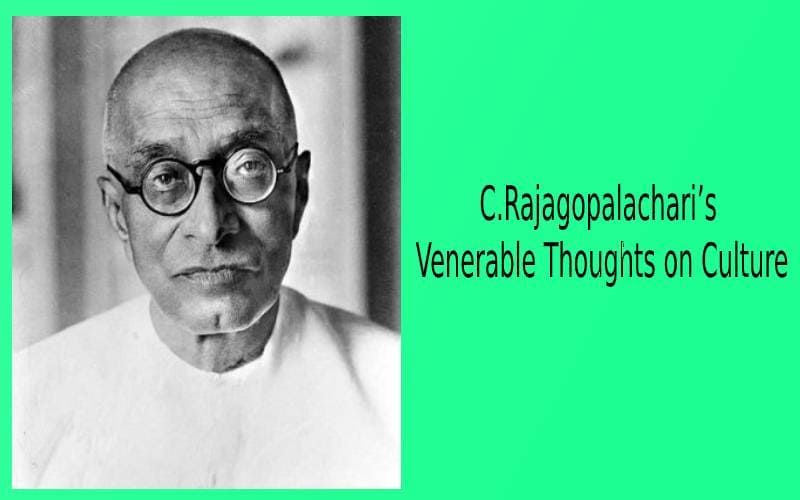
C.Rajagopalachari’s Venerable Thoughts on Culture

C.Rajagopalachari’s Venerable Thoughts on Culture C.Rajagopalachari’s Venerable Thoughts on Culture Chandrasekaran Balakrishnan November 20, 2024 Indian Liberals   Around the world, a human civilisation evolved over thousands of centuries ago on an undesigned pattern but their understanding of nature and by its forces paved actions shaped their desirous and quests. The laws of nature were the first instrument to form their quests to understand the reasons for human evolution and embarked on various dimensions like culture, social norms, and economic prosperity.   Since then, the human civilisation continues to make attempts to progress further on cultural values, shared social norms, and materials accumulation through trade. Whilst, we tend to track back the origins of human civilisation along with their pattern and endurance of culture, social milieus, and economic status giving importance as much as the future.  Since time immemorial, human civilisation seems to be pursued to inquire about the evolution of the cosmos, man, and desires in life. It so happens that many things that evolved around the man and his community were always quite spontaneous combining the collective behaviour of a group of people or a community. Some of the basic aspects are like desires of pleasures, languages, desire to accumulate materials, cultivate norms and values for social virtues including culture, etc. As we look back from the perspective of the twenty-first century; several centuries ago, man paved and nourished many facets of sobering endurances of culture which penetrates among the community and individual practices in daily life. The most inevitable aspect of any culture across the world is keeping oneself cleanly in body, dressed up with clothes, etc.   According to a great scholar, C.Rajagopalachari “civilisation in the true sense of the word is the development of restraint. The consensus of society, the total combined will of the people living together, seeks to curb the individual’s tendency to overdo the use of his senses. This is the difference between civilisation and barbarism.”  The word culture denotes many things to many countries. But undoubtedly, it is one of the most misused and abused words in every literature. The word culture is also most confused among people during the debate and discussions in the domain of politics, administrations, social reforms, renaissance, etc.  Chakravarti Rajagopalachari (1878-1972) was one of the greatest scholars of twentieth-century India. He was a multifaceted personality. He was a visionary and thinker. He ventured into many fields and excelled at great depth, like a legal and constitutional expert, freedom fighter and astute politician, a scholar in Indian literature, classical liberal thinker, statesman, an able administrator, scholar in Tamil literature, prolific writer, and author of hundreds of books, etc.  He was fondly called as Rajaji or C.R. by many. He was among few scholars who applied their mind into deep musing about what is culture not just in India but also of the other nations and how it evolves around the people’s social and economic progress. In the late 1950s, Rajaji was invited by Bharatiya Vidya Bhavan, Mumbai to deliver a series of lectures on Culture. The Bhavan later published the lectures in a slim book which went several editions over the years since then.  Rajaji was a principled man and hesitated to give lectures on Culture. Though he has mastered and written quite copiously on Indian literature and knew world history, philosophy, and culture. He warned, however, that “nothing can be expected from me on music, dance, the theatre or the silver screen” which were and still considered as the culture but these alone did not describe Rajaji. He spoke about the process of evolution of the culture of different nations and the case of India.   He succinctly asked “how to utilise the traditional position to the best advantage for the general community, Shall we try to enforce the obligation on the individual in respect of the entire whole and reconcile ourselves to lapses and failures? Or Shall we utilise the natural force actually prevailing in smaller circles and add it all upto make it serve the whole?”  According to Rajaji “the way of living built up by groups of human beings and transmitted from one generation to another. People each with their own long history build up separate patterns of cultures. There is much that is common, but also a great deal that is particular to each nation.” Further, “culture is not literacy or ability to play on the veena” said Rajaji, but “it has to do with general behaviour, speech, and conduct, and is different from goodness and badness of character.” Think about behaviour of political leaders in contemporary India. Also, think about behaviour of spiritual leaders across different faiths, the goodness and badness would vividly expose their character and their culture.  Unlike our confused textbooks in schools and colleges, Rajaji defines that “culture is not just character or morality. Character is the inside of a man. Culture is external rather than internal. Culture has more to do with behaviour and way of living than with character. Broadly speaking, culture is external though of course, it has much to do with character too. Because, the outside has always much to do with the inside.” In contrast, we tend to witness mostly in our public life wherein one conducts on a confused state of affairs of both character-wise and established morality of the culture.      Most of the contemporary social ills have strong negative influences of distortions of cultural values of communities in different countries including India. Partly, the government system seems to be a vital force paving towards distortions of communities’ culture which imposes restraints on an individual without force or completion. “Civilisation is not mere advance in technology and in the material aspects of life” warned Rajaji. “We should remember it is an abstract noun and indicates a state of living and not things. Mainly, civilisation connotes the curbing of wildness, barbarity, and over- indulgence of passions and appetites” observed Rajaji.  According to Rajaji “civilisation has two instruments to achieve the object of curbing the sensual instincts and preventing or deterring over-indulgence.” He explains that one instrument is the government’s enforcement of the

C.Rajagopalachari’s Venerable Thoughts on Culture Read More »

GK Sundaram: Swatantra’s Forgotten Tamil Leader

GK Sundaram: Swatantra’s Forgotten Tamil Leader GK Sundaram: Swatantra’s Forgotten Tamil Leader When the permit – quota, license Raj laid steel claws on the nation’s economy, GK Sundaram campaigned fearlessly in support of freedom. During his fateful years in the Rajya Sabha as a Swatantra Party member and outside the house, he emphasised and re-emphasised the basic truth that socialism is to social justice what ritual is to religion and dogma is to the truth. He has consistently championed the cause of fruitful egalitarianism in the place of sterile socialism. Chandrasekaran Balakrishnan November 20, 2024 Indian Liberals   The world economy and the health care system are in havoc never seen before after the Second World War due to the speedy spread of COVID19 across the world. In India, few leaders argue with perceptive thinking on the rationale for a complete lockdown of the entire economy by a whip of the Union Government. Industrialist Rajiv Bajaj is one such leader and argues based on certain data analysis which is India centric and has some grain of truths. Bajaj’s open mind and incredible courage to think alternative ways are quite rare at this juncture of impaired moral fabric all across the world. History witnesses that only a few righteous persons could think or take the risk without fear or consequences. Decades ago, we had a few such rare thinkers. GK Sundaram was one such great thinker and leader from Coimbatore, Tamil Nadu. “He has led a historic life. He was a great visionary and a perfect and righteous person”. He was multifaceted personality contributed immensely to the country’s freedom struggles even at the tender age of 16. He also served considerable time in prison and was a doyen of the Indian textiles industry, builder of many industry bodies for supporting the growth of the textiles sector. He was a tall political leader and a parliamentarian of Swatantra Party, an educationist a philanthropist, and above all, a liberal thinker with a firm belief of economic freedom, individual liberty and equality for all. GK Sundaram had once unequivocally stated that “Individuals should be allowed to pursue their vocations without let or hindrance – there should be no unnecessary governmental interference. We believe in freedom of enterprise because it is the only system that can uphold and protect individual liberty which is paramount and matters more than anything else”. He was inspired by Nani Palkhivala’s annual post Union Budget speeches and delivered several such post Union Budget speeches in Coimbatore at the “Verandah Club” with humour and stressed on the ills of State control policies of the government. GK Sundaram was born in 1914 in Coimbatore. He was affectionately called GKS. He completed a course in Textile Technology at Bolton in the UK and returned to join as Manager in his father’s family business in the textile sector in Coimbatore in 1938. His father, a Congressman, G Kuppuswamy Naidu had started business in the textile sector in 1910. For about seven decades, Sundaram was Chairman and Managing Director of Lakshmi Mills Ltd. He was also the Chairman of Lakshmi Automatic Loom Works Limited and the Lakshmi Card Clothing Manufacturing Company. Today, the Lakshmi group has diversified businesses leading in several areas. It also provides free healthcare services to the poor and serves free cooked food with the aim that no one should go hungry in the city of Coimbatore.  Coimbatore is known as Manchester of South India, a long-standing tradition of a manufacturing hub for all kinds of goods and services from agriculture, to industry and the service sector. Much before the economic reforms, GK Sundaram was a pioneer in collaborating with many overseas businesses to produce world-class textile machinery in India and established a diversified and profitable business for his company. During the freedom struggles and the following socialist command and control regime after independence, GK Sundaram led the growth and development of the Indian textiles sector by introducing new technology in processing and manufacturing. He was behind the promotion of Suvin cotton, an indigenous variety of cotton in the country. It was because of his support, the Extra Long Staple (ELS) variety of cotton was developed in India. He was against price controls and had strongly advocated for a fair price for cotton in India, which was equal to the international market price.     GKS founded and spearheaded several industry bodies to train human resources and also raise voice over ill policies and sensitise the governments. GK Sundaram was the founder and president of the South India Cotton Association from 1978 to 1998. He was the chairman of the Southern India Mills Association from 1967 to 1969 and of the South India Textile Research Association from 1982 to 1998. He was president of the Indian Chamber of Commerce and Industry, Coimbatore from 1962 to 1986; and founder and president of the Coimbatore Management Association from 1955 to 1971 and Wind Power Producers Organisation. He was also the chairman of the Indian Cotton Mills Federation, now known as the Confederation of Indian Textile Industry, from 1973 to 1975. After involving for several decades of political activism during freedom movements and post-independent India, mostly on liberal principles, Rajaji founded the Swatantra Party in 1959 along with likeminded classical liberals. They had a vision for the country and ventured to effectively counter the socialistic and statist economic policies of Jawaharlal Nehru, who betrayed Gandhi’s vision and aspirations of millions who participated in the freedom struggle. According to Rajesh Govindarajulu “The Swatantra Party had a number of adherents in Tamil Nadu and in Coimbatore. Saw. Ganesan (Kambanadipodi), B Venkataswamy, Mariswamy, Venkat Rao, VP Kandaswamy, Kovai Subri – the freedom fighter, Kalki Sadasivam, and the freedom fighter industrialist GK Sundaram.” Also, Kovai Khadar Ayyamuthu, R Krishnamurthy, Advocate Sundaram, Gobi Sami Gounder and NA Parasuraman were active leaders in the State. Sundaram was not only attracted to classical liberal principles but was closely mentored by C Rajagopalachari in his political career and thought process. On his 90th birthday, he had reprinted Rajaji’s Speeches rendered as the Governor-General after independence. GK Sundaram

GK Sundaram: Swatantra’s Forgotten Tamil Leader Read More »

Mariadas Ruthnaswamy: Liberal Educationalist, Statesman and Writer

Mariadas Ruthnaswamy: Liberal Educationalist, Statesman and Writer Mariadas Ruthnaswamy: Liberal Educationalist, Statesman and Writer Few have had such a varied and distinguished public service spanning a few decades. Ruthnaswamy was a leading educationist and professor of Indian history and politics, liberal thinker, constitutionalist, politician, parliamentarian, erudite orator, editor, administrator, and author. He was founding Vice President of Swatantra Party and represented the party form Madras State in the Upper House (Rajya Sabha) of the Parliament for two terms. Chandrasekaran Balakrishnan November 20, 2024 Indian Liberals During the last century, Tamil Nadu has produced many political leaders, liberal scholars, constitutionalists, social reformers, and public policy thinkers of far excellence. But the quality of the last half of the century’s polity in Tamil Nadu had merely served for advancing the one’s ego on others for gaining the vote motives. This has been the case at least since 1966, involving massive indoctrination of one particular ideology and distortion of classical liberal thinkers’ thoughts.  Thoughts of some of the leading scholars on classical liberal principles were not only forgotten but perceptively neglected in all spheres of the mainstream practices. Furthermore, this era became an ideal hero-worship of political leaders without much thought about the indoctrination of the youth. The tragedy is that even after three decades of the first wave of economic reforms and free-market economic policies, the ignorance over the relevance of classical liberals’ thoughts continues.  One of the great liberal scholars in recent times was Mariadas Ruthnaswamy. He was born in August 1885 at Royapuram in Madras (now Chennai) to MI Ruthnaswamy and MT Ruthnaswamy. Mariadas Ruthnaswamy was an authority on Indian history, political theory, and economics and often differed from others. Few have had such a varied and distinguished public service spanning a few decades. Ruthnaswamy was a leading educationist and professor of Indian history and politics, liberal thinker, constitutionalist, politician, parliamentarian, erudite orator, editor, administrator, and author. He was founding Vice President of Swatantra Party and represented the party form Madras State in the Upper House (Rajya Sabha) of the Parliament for two terms.  Mariadas Ruthnaswamy received school education at St. Anne’s School at Secunderabad in Andhra Pradesh, and matriculated from the St. Joseph’s College at Cuddalore in Madras Presidency (now Tamil Nadu) in 1903. He also completed his undergraduate education at Nizam’s College, Hyderabad in 1907. Thereafter, he went to England to study at Jesus College, at Oxford University and University of Cambridge and completed his History Tripos degree in 1910. At Cambridge University, he was contemporary of Jawaharlal Nehru. Simultaneously, he was enrolled for law at Gray’s Inn, London, and became a barrister in 1910. In 1911, he returned to India and was determined not to practice law despite his father’s pressure. In 1921, Mariadas Ruthnaswamy was appointed as the first Indian Principal of Pachiyappas College, Madras (now Chennai), which was one of the leading educational institutions in the Madras Presidency. He served as Principal and also Professor for English, History, and Politics till 1927. Later, he was appointed as the first Indian to hold the post of Principal of Madras Law College in 1928 and served up to 1930. Afterward, he became the Vice-Chancellor of Annamalai University at Chidambaram in Madras Presidency from 1942 to 1948. During the period from 1930 to 1942, Mariadas Ruthnaswamy served as Member of Madras Service Commission (now TNPSC) and also chaired the Commission for some time in later years. This Commission was one of the first to be established (1929) in the country among all the Presidencies. Mariadas Ruthnaswamy’s political career spans more than half a century. He was associated with the Justice Party in Madras since 1919, but after it was dissolved in 1944, he remained independent until he joined the Swatantra Party in 1959, founded by C Rajagopalachari among others. Mariadas Ruthnaswamy was first elected as Councillor in the Corporation of Madras in 1921 and served till 1923. And then, at the age of 40, he became Member of Madras Legislative Council and also President of the Council and served from September 1925 to November 1926. In the Council debates, he was known for his wit and quick repartee. He was a practising liberal constitutionalist, and in 1927, he was nominated as Member of the Central Legislative Assembly.  Swatantra Party nominated Mariadas Ruthnaswamy as a Member of the Rajya Sabha for two terms: first from 1962 to 1968 and second from 1968 to 1974. His speeches were eloquent and powerfully delivered in the Parliament covered a wide range of subjects lucidly and incisively. In 1968, the Government of India conferred Ruthnaswamy with the Padma Bhushan for his work in Literature and Education in Madras. This was one of the rare occasions when the leader of the opposition (Rajya Sabha) was conferred such an award. He was actively involved in activities of the Parliament and participated in all important discussions and debates as leader of the Swatantra Party. Mariadas Ruthnaswamy was also a prolific writer, known for his erudition and knowledge of Indian history as well as many other subjects. He contributed articles regularly in the national newspapers like Sunday Standard, Statesman, and journals like Swarajya, The Week, and local newspapers like Madras Mail and Daily Express, Madras. He was editor of both English and Tamil journals publications such as Standard (1921–1923), the weekly edition of The Democrat (1950–1955), daily edition of Tamil Nadu (1951–1955) and fortnightly edition of Thondan (1972). He had published classical liberal economic ideas in The Democrat and journals like Swarajya. He was an extraordinary leader. Ruthnaswamy believed in the principles of constitutional methods and political education for achieving freedom from the British. He was against too much focus on political power and concentrated on economic freedom.  Mariadas Ruthnaswamy wrote several scholarly books published both in India and England. All in his masterly works, he explained quite vividly his in-depth thinking on the power of ideas, institutional systems, and men of characteristics that shape the institutions’ life and structure in an economy and democracy. His major works include The Political Philosophy of Mr. Gandhi (1922), The Political Theory of the Government of India (1928) – this

Mariadas Ruthnaswamy: Liberal Educationalist, Statesman and Writer Read More »

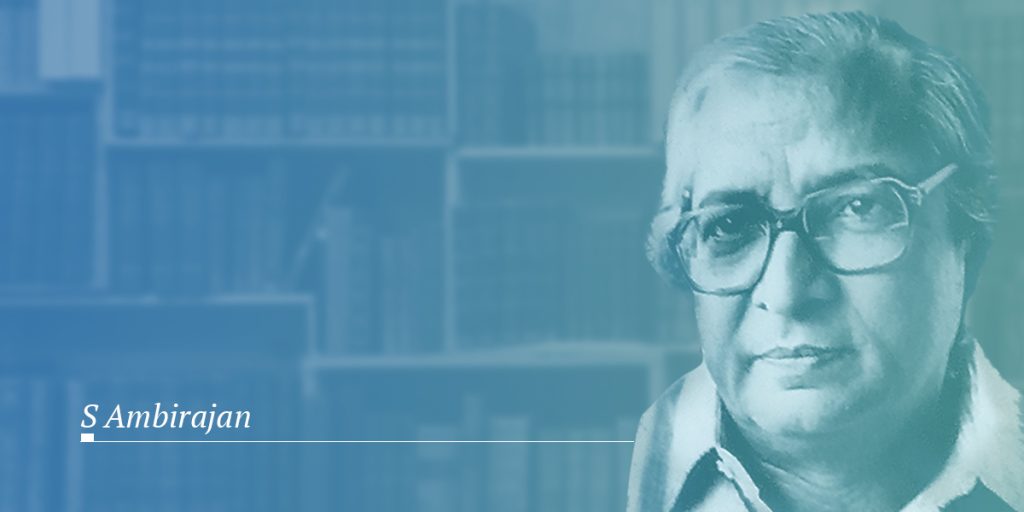
S Ambirajan’s forgotten classic `A Grammar of Indian Planning (1959)’

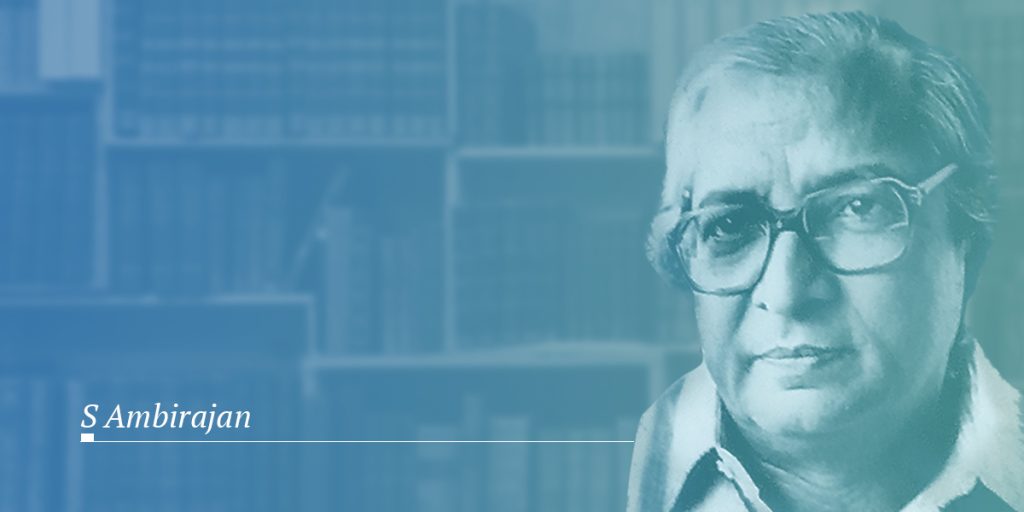
S Ambirajan’s forgotten classic `A Grammar of Indian Planning (1959)’ S Ambirajan’s forgotten classic `A Grammar of Indian Planning (1959)’ Ambirajan felt deep anguish over Nehru’s dilution of attention, ill-attempts to reconstruct the economy and instead of pushing it towards prosperity, indulging in mere rhetoric. He noted: “We cherish our hard-won freedom, and we do not wish to change the essential character of our sovereign democratic republic. But we wish also to achieve freedom from hunger, from squalor, from ignorance, and from idleness, for without these freedoms, mere political freedom can have no meaning for long.” Golden words. Chandrasekaran Balakrishnan July 29, 2020 Indian Liberals Independent India was obsessed with the idea of centralised planning, sadly, minus scientific logic and reasoning and an avoidable penchant for blindly aping other countries. Truth be told, however, the idea of centralised planning was uppermost in the minds of mainstream political leaders, at least since the 1930s – particularly those who were determined to play a major role in independent India. However, anyone with common sense, logic and sound reasoning powers would have seen that the quest for wealth creation would vary from country to country, and in the case of a vast country like India, from region to region. Despite adopting a liberal Constitution, which enshrined the values of economic freedom, liberty and property rights in a free society, centralised planning became the byword for those in the new Indian administration, despite the resistance posed by few well-meaning leaders.  In the absence of well thought out projects and with no institutional mechanisms in place, centralised economy became a plaything in the hand of neo-colonialists who came to rule and dominate independent India’s economic planning. Alas, the shackles of centralised planning continue even seven decades since independence, which has been invariably turned out to be non-productive for a functional democracy like India. Centralised planning has sustained itself over the decades because elected representatives, who hold offices, have enjoyed the fruits of power without a care for implementing economic policies in a decentralised manner. For any elected government over the years, decentralised planning had become an anathema. It was not always like this. The actual experience of India’s centralised planning both before and after 1947, and up to the First Two Five Year Plans -1951-56 and 1956-61 – was meticulously captured in a marvelous account called A Grammar of Indian Planning by Professor S Ambirajan, which was published in 1959 in the heyday of India’s centralised planned economy. A classic, this first book by this great liberal mind, captured the gigantic architecture of centralised planning in the Indian sub-continent with detailed and vast notes of appendix on China and Pakistan.  In 1959, Prof Ambirajan was a young scholar, but A Grammar of Indian Planning included vast literary references, expostulating on the status of political economy, the planning process of British colonies and of major countries like the USA, USSR, Germany, Japan and Australia. He was well versed with the treatises of classical economics of the 19th century, the emerging theories of Fabian socialism and communist literature. Besides, his second book Malthus and Classical Economics was already in the press.  With such deep intellectual insights and a thorough reading of economic literature post-World War II, Ambirajan was pained by the way the Jawaharlal Nehru government dealt with centralised planning for development and growth of the Indian economy. He was not just well aware of the emerging, if contentious, debates on centralised planning as proposed by C Rajagopalachari, M Ruthnaswamy, B R Shenoy and Prof P S Lokanathan, among others, but also well versed with the writings of the Austrian School of economists like Ludwig Von Mises, F A Hayek and Peter T Bauer. Traditionally, this school emphasises the spontaneous organising power of the price mechanism and holds that the complexity of subjective human choices makes mathematical modeling of the evolving market practically impossible, a template that Indian planners chose to ignore.    Prof Ambirajan’s intention to write the book was two-fold – a deep inclination to understand the idea of planning in the Indian context, which meant compromising democracy inherent in the Indian Constitution, as well as to examine how it was used elsewhere in the world. A part of the first chapter of the book first appeared as article in the Swatantra on October 1, 1955. Prof Ambirajan studied the documents of the Bombay Plan, the MN Roy Plan, Gandhian Plan and Gandhism Reconsidered, commenting acerbically: “With so much talk of planning filling the air, even the bureaucracy felt the infection and thought the time had come to act.”  But he had little faith in the role of the bureaucracy of Independent India, which according to him, was the same as the British, albeit in different hands: “Fourteen years later, it should now be possible to take a more charitable view of the Government’s endeavours to plan our future. It was no doubt piecemeal planning, it was bureaucracy-bred and red-tape governed; but all the same, those Plans, and proposals were the first attempts at national planning at Government level…” Ambirajan felt deep anguish over Nehru’s dilution of attention, ill-attempts to reconstruct the economy and instead of pushing it towards prosperity, indulging in mere rhetoric. He noted: “We cherish our hard-won freedom, and we do not wish to change the essential character of our sovereign democratic republic. But we wish also to achieve freedom from hunger, from squalor, from ignorance, and from idleness, for without these freedoms, mere political freedom can have no meaning for long.” Golden words.  On centralised planning, he profoundly, demonstrated both the philosophical and the real impact of what it entailed. “There are unpredictable and imponderables in human life which are forever beyond the purview of the planners,” he said, adding, “It would, therefore, be foolish on the part of the administrator to impose one particular type of economic growth drawn from the experience of one country on the economy of another country. The movement of economic progress of a country must follow its own path, based on its history, aptitudes, and other determining

S Ambirajan’s forgotten classic `A Grammar of Indian Planning (1959)’ Read More »

Venkataraman Sundaram-Scholar, Economist and Civil Servant (1942-2014)

Venkataraman Sundaram-Scholar, Economist and Civil Servant (1942-2014) Venkataraman Sundaram-Scholar, Economist and Civil Servant (1942-2014) An indefatigable proponent of nationalism with free-market economics and against the ideas of communism and socialism, he noted, pithily: “Rajaji spoke against the ‘Licence-Permit-Control-Quota Raj’ in the 1950s and 1960s. If he had been in our midst today, he would have spoken against the ‘Licence-Permit-Control-Quota Raj’ created by our politicians in the field of professional, higher and university education.” Chandrasekaran Balakrishnan July 9, 2020 Indian Liberals Seven decades after Independence, a nation, which is more a continent than a country, continues to be in evolution, struggling to ensure basics to its billion-plus people. It should not have taken this long in a functional democracy, only if its legislature and its executive were sensible enough to implement the constitutional provisions of equal freedom and opportunities to people.   However, India’s face has changed significantly after embarking on the road to economic liberalisation three decades ago. It becomes important, therefore, to inquire why the Indian economy was stilted before 1991, even though the answers are now well known: the institutional framework premised to deliver the fruits of democracy were not only utterly weak, but often hand in gloves with reactionaries, masquerading as progressives.   Yet, the landscape was not bereft of outstanding scholars, thinkers, economists and civil servants – like Venkataraman Sundaram – who warned against the pitfalls of dictatorship and narrow economic determinism. In his career as a civil servant, Sundaram strove for improvements in government delivery systems. He wore many hats with equal proficiency – scholar, economist, writer, author and a fearless journalist. A multi-dimensional personality, his contribution to public policy, historical analysis, poetry and a collector of rare books, sets him apart from the crowd. He strongly believed that without unfettered “civil liberty, individual freedom and political democracy” India cannot achieve economic prosperity.  Sundaram served as civil servant in Tamil Nadu for 29 years. He was Principal Secretary to the Government of Tamil Nadu before he opted for voluntary retirement from the Indian Administrative Service (IAS) in 1994, aged 51. He quit in disgust and said it in as many words.  “I quit in disgust… I got fed up with the corrupt system and politicians around me who fail to learn anything either from history or the present.” Both in the government and outside it, Sundaram was known for his independence and courage of conviction.  In one of his more famous orations delivered in 1982 as Director of the Anna Institute of Management, Chennai, Sundaram noted that “When the public sits in judgment on any public servant, they are bound to ask four questions. Was he a man of judgment? Was he a man of vision? Was he a man of courage? Was he a man of integrity?” All questions remain highly relevant even today.   Sundaram was a crusader against the denuding of Tamil Nadu’s natural resources and beach minerals. He believed that being neutral in public was tantamount to committing suicide. In the process, he deliberately veered towards Right Wing analysis, of course, well-backed and supported by data.  Sundaram was born on August 28, 1942, at Trichy in Tamil Nadu, and did his schooling in Shimla and New Delhi. He completed his school education at the Madrasi Higher Secondary School, New Delhi in 1958 and studied Tamil from eminent writer and teacher Dr ‘Indira’ Parthasarathy. He graduated in Economics from St. Stephen’s College, Delhi, in 1961 and finished post-graduation in Economics with specialisation in Industrial Economics from Delhi University in 1963. Between 1963-1965, he was lecturer in Economics at Delhi University’s Dyal Singh College. In 1965, aged 23, he cleared the Indian Administrative Service (IAS), moving to Madras (now Chennai) after being allotted the Tamil Nadu cadre. He served with distinction in several important positions in the state government from 1966 to 1994.  Posted as Collector in the southern districts of Tamil Nadu, Sundaram was instrumental in developing the Tuticorin Port Trust as Chairman, putting it on the Maritime Map of South East Asia. He played a major role in bringing the branded sunflower oil Sunola as Managing Director of the Tamil Nadu Agro-Industries Corporation Ltd. In record time, he was instrumental in completing the development of Tirupur Industrial Complex for export of textiles and garments, in 1991-92.   Sundaram excelled in many roles: Commissioner and Secretary to Government in the Department of Institutional Finance, Rural Development, Food and Consumer Protection, Public Works Department (PWD) and Personnel and Administrative Reforms. As Secretary PWD, he played a big part in the acceleration of privatisation of the power sector.  Post-retirement, he held many responsible positions, both in the public and private sectors. He was Administrator of the World Bank-assisted National Highways projects. For two years, he was Secretary-General of the Hindustan Chamber of Commerce, Chennai.  A prolific author, Sundaram wrote several books including Growth with Equity (1987), Essays and Reviews (1993), District Administration (1993), Essays in Welfare Administration (1993), Rama Setu—Historical Facts and Political Fiction (2007), Tamil Scholars and Savants (2011), and Elegies on Padma (2012), to mention only a few.  After quitting the civil service, he was Associate Editor of The News Today (a daily in English) and Malai Sudar (a Tamil daily) from 2005-2010 and wrote innumerable scholarly articles in English in their columns.  To judge him as a Hindutva apologist by reading a few of his articles will be misleading; only a thorough reading of his scholarly treatises would help appreciate his position on different subjects.  Sundaram vehemently criticised India’s first Prime Minister for implementing policies through centralised planning. He stated: “…centralised planning process introduced by Jawaharlal Nehru in 1950, with experts like Mahalanobis determining the targets and allocation of resources cannot be an effective model today.” He was scathing in his observations. “…The invasion of Nehruvian secularism which started on August 15, 1947, and is still continuing unabated and unchallenged, clothed in the aura of official authority, now institutionalised … It is because of this politically motivated and criminally perpetrated hiatus between a false nation and a truly blood-sucking State that there is

Venkataraman Sundaram-Scholar, Economist and Civil Servant (1942-2014) Read More »

S Ambirajan – the forgotten liberal political economist (1936-2001)

S Ambirajan – the forgotten liberal political economist (1936-2001) S Ambirajan – the forgotten liberal political economist (1936-2001) Prof Ambirajan was a prolific writer for over four decades and published more than two dozen scholarly books and monographs, among other works, which were appreciated among renowned scholars across the world. He wrote hundreds of articles and columns in The Hindu and The Economic Times for several years. Sad to say, but his scholarly works have found more takers abroad than in his own country or state, where his papers have not been accorded the respect they deserve. Chandrasekaran Balakrishnan June 23, 2020 Indian Liberals Independent India was obsessed with the idea of centralised planning, sadly, minus scientific logic and reasoning and an avoidable penchant for blindly aping other countries. Truth be told, however, the idea of centralised planning was uppermost in the minds of mainstream political leaders, at least since the 1930s – particularly those who were determined to play a major role in independent India. However, anyone with common sense, logic and sound reasoning powers would have seen that the quest for wealth creation would vary from country to country, and in the case of a vast country like India, from region to region. Despite adopting a liberal Constitution, which enshrined the values of economic freedom, liberty and property rights in a free society, centralised planning became the byword for those in the new Indian administration, despite the resistance posed by few well-meaning leaders.  In the absence of well thought out projects and with no institutional mechanisms in place, centralised economy became a plaything in the hand of neo-colonialists who came to rule and dominate independent India’s economic planning. Alas, the shackles of centralised planning continue even seven decades since independence, which has been invariably turned out to be non-productive for a functional democracy like India. Centralised planning has sustained itself over the decades because elected representatives, who hold offices, have enjoyed the fruits of power without a care for implementing economic policies in a decentralised manner. For any elected government over the years, decentralised planning had become an anathema. It was not always like this. The actual experience of India’s centralised planning both before and after 1947, and up to the First Two Five Year Plans -1951-56 and 1956-61 – was meticulously captured in a marvelous account called A Grammar of Indian Planning by Professor S Ambirajan, which was published in 1959 in the heyday of India’s centralised planned economy. A classic, this first book by this great liberal mind, captured the gigantic architecture of centralised planning in the Indian sub-continent with detailed and vast notes of appendix on China and Pakistan.  In 1959, Prof Ambirajan was a young scholar, but A Grammar of Indian Planning included vast literary references, expostulating on the status of political economy, the planning process of British colonies and of major countries like the USA, USSR, Germany, Japan and Australia. He was well versed with the treatises of classical economics of the 19th century, the emerging theories of Fabian socialism and communist literature. Besides, his second book Malthus and Classical Economics was already in the press.  With such deep intellectual insights and a thorough reading of economic literature post-World War II, Ambirajan was pained by the way the Jawaharlal Nehru government dealt with centralised planning for development and growth of the Indian economy. He was not just well aware of the emerging, if contentious, debates on centralised planning as proposed by C Rajagopalachari, M Ruthnaswamy, B R Shenoy and Prof P S Lokanathan, among others, but also well versed with the writings of the Austrian School of economists like Ludwig Von Mises, F A Hayek and Peter T Bauer. Traditionally, this school emphasises the spontaneous organising power of the price mechanism and holds that the complexity of subjective human choices makes mathematical modeling of the evolving market practically impossible, a template that Indian planners chose to ignore.    Prof Ambirajan’s intention to write the book was two-fold – a deep inclination to understand the idea of planning in the Indian context, which meant compromising democracy inherent in the Indian Constitution, as well as to examine how it was used elsewhere in the world. A part of the first chapter of the book first appeared as article in the Swatantra on October 1, 1955. Prof Ambirajan studied the documents of the Bombay Plan, the MN Roy Plan, Gandhian Plan and Gandhism Reconsidered, commenting acerbically: “With so much talk of planning filling the air, even the bureaucracy felt the infection and thought the time had come to act.”  But he had little faith in the role of the bureaucracy of Independent India, which according to him, was the same as the British, albeit in different hands: “Fourteen years later, it should now be possible to take a more charitable view of the Government’s endeavours to plan our future. It was no doubt piecemeal planning, it was bureaucracy-bred and red-tape governed; but all the same, those Plans, and proposals were the first attempts at national planning at Government level…” Ambirajan felt deep anguish over Nehru’s dilution of attention, ill-attempts to reconstruct the economy and instead of pushing it towards prosperity, indulging in mere rhetoric. He noted: “We cherish our hard-won freedom, and we do not wish to change the essential character of our sovereign democratic republic. But we wish also to achieve freedom from hunger, from squalor, from ignorance, and from idleness, for without these freedoms, mere political freedom can have no meaning for long.” Golden words.  On centralised planning, he profoundly, demonstrated both the philosophical and the real impact of what it entailed. “There are unpredictable and imponderables in human life which are forever beyond the purview of the planners,” he said, adding, “It would, therefore, be foolish on the part of the administrator to impose one particular type of economic growth drawn from the experience of one country on the economy of another country. The movement of economic progress of a country must follow its own path, based on its history, aptitudes, and other determining circumstances.”

S Ambirajan – the forgotten liberal political economist (1936-2001) Read More »

SV Chitti Babu, academician, educationist and reformer par excellence (1920-2020)

SV Chitti Babu, academician, educationist and reformer par excellence (1920-2020) SV Chitti Babu, academician, educationist and reformer par excellence (1920-2020) Chitti Babu was an able administrator in several higher educational institutions and can be credited for introducing many reforms in Tamil Nadu. According to him, educational and training institutes needed to identify and inculcate students’ talents and improve their capacities to handle societal situations with skill, rather than mere socialization. For a lifelong, he strove for `providing equality of opportunities to all its citizens’ in the field of education. Chandrasekaran Balakrishnan June 18, 2020 Indian Liberals India’s contemporary society is such that it scarcely pays attention to someone’s multi-decadal achievements, to one who is a doyen in many fields – unless he or she belongs to the ranks of popular politicians, cine actors, fiction writers, directors of cinema or industrialists.  It is even stranger that nonagenarians are recognized not just for their age, but also their lifelong contributions to chosen field of excellence that spans many decades. Late Professor S.V.Chitti Babu, a leading intellectual educationist of the country, was one such person.  He was an educational reformer, who served for more than six decades in various capacities. A lifelong policy wonk, he worked for improving the quality of education in schools, colleges and universities in India and Tamil Nadu.  Chitti Babu was an able administrator in several higher educational institutions and can be credited for introducing many reforms in Tamil Nadu. According to him, educational and training institutes needed to identify and inculcate students’ talents and improve their capacities to handle societal situations with skill, rather than mere socialization. For a lifelong, he strove for `providing equality of opportunities to all its citizens’ in the field of education.  The veteran’s achievements in the field of school reforms and the positions he adopted in the annals of India’s educational history, is a case study to learn and imbibe about meeting systemic transitions and challenges that are resolved over many decades.  The eminent educationist passed away on March 29, 2020, at Chennai, celebrating his hundredth birthday on November 7, 2019. He had diabetes for close to six decades, but that never came in the way of his active engagement in public life, taking on a different role every time to bring policy changes in the education sector.  Prof Chitti Babu stood tall in the field of education. For decades, many in the state turned to him to resolve the myriad issues and challenges faced in this crucial sector. His pragmatic views and suggestions were welcomed by one and all, as they provided succor to everyone who sought help. The nonagenarian headed many committees and commissions, coopting himself in the role of even a simple member in committees related to the education sector, both in Tamil Nadu and the national level.  Chitti Babu had published widely, writing more than a 100 scholarly articles and lectures on the issues confronting the education sector, which are still relevant for his splendid articulation, context and content.  The centenarian was born on November 7, 1920. He received his B.A. (Hons) in History from the Pachaiyappa College, Chennai. He concluded his M.A. degree in History from the University of Madras. In 1942, he joined as Assistant Professor of History at the Pachaiyappa College.  Babu became Professor in 1947, teaching in many colleges, including the prestigious Madras President College. He was the first Principal of the Government Training College, Vellore, a Fulbright Scholar who trained in the USA and went on to become member of the State Planning Commission. As Vice-Chancellor at the Madurai Kamaraj University from 1975 to 1978, he was the first in the country to spearhead and introduce Distance Learning in Tamil Nadu for higher education, apart from introducing semester and internal assessment systems.  Chitti Babu served two terms as Vice-Chancellor of the Annamalai University from 1950-86, leaving his imprimatur there with many far-reaching reforms, including the introduction of Distance Education. He was honoured with the D.Litt. degree (Honoris Causa) for his yeoman services.  He was also the first Vice-Chairman of Tamil Nadu State Council of Higher Education established in 1992, also serving as Member in the Executive Committee of Association of Commonwealth Universities.  Chitti Babu travelled to several countries for keeping abreast with educational issues, enlarging his learning and broadening his horizon. In 1994, he founded the Tamil Nadu History Congress and was its President for a decade.  He was the first Director of School Education and Higher Education Departments of the Government of Tamil Nadu. While serving there, he was told that without teachers’ training, he could not grow beyond a point; hence at the age of 32 in 1951-52, Chitti Babu took leave from work for a year and joined the Collegiate Teachers’ Certificate course at Teacher Training College, Saidapet in Chennai, which is also one of the oldest teacher training institutes in Asia.  In 1991, he headed a committee constituted by the Government of Tamil Nadu to study the status of unrecognised English medium nursery schools run by private individuals. His brief was to recommend regulations for controlling and monitoring such schools. In 1993, the state government had notified various regulatory measures for control and monitoring proposed by him.  It was during this period that mushrooming of private English-medium nursery schools proliferated across Tamil Nadu. Indeed, the failure to safeguard the interest of parents and children prompted the government to step in and regulate.  After the tragic demise of 96 children in a school fire at Kumbakonam, Tamil Nadu, in 2004, Prof Chitti Babu headed a Commission constituted by the state government to study and prescribe the fee structure of such schools. It was also mandated to introduce minimum infrastructure facilities, including the land area for each school depending upon its location, and the salary structure of teachers of private matriculation schools and private matriculation Higher Secondary schools. Again, another market failure warranted a second government intervention.  The Commission’s recommendations created a huge controversy in Tamil Nadu. Some private schools even went

SV Chitti Babu, academician, educationist and reformer par excellence (1920-2020) Read More »

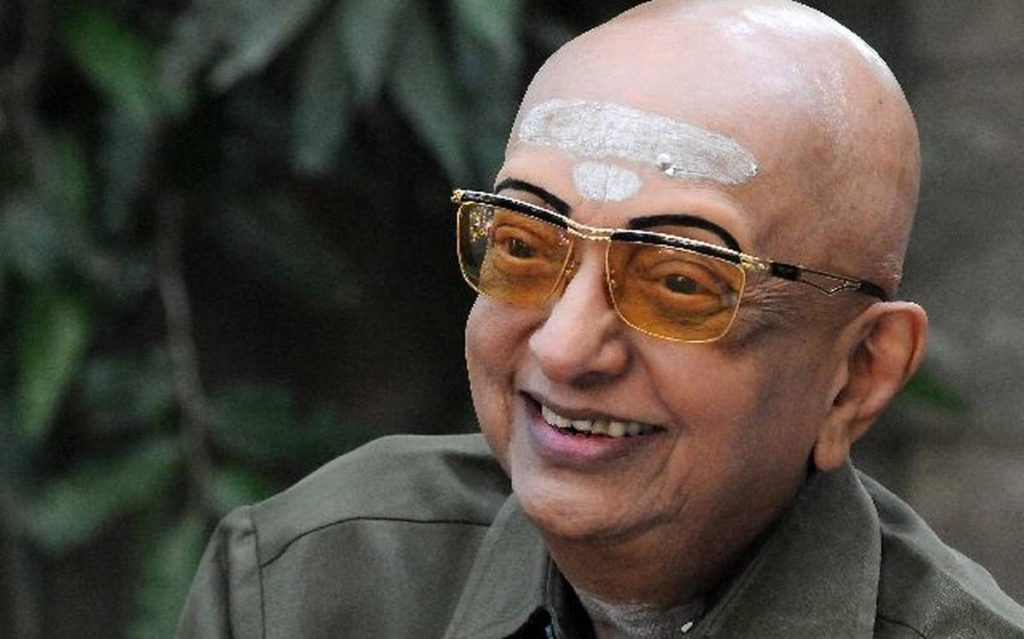
Cho Ramaswamy: India’s classical satirist and liberal, 1934-2016

Cho Ramaswamy: India’s classical satirist and liberal, 1934-2016 Cho Ramaswamy: India’s classical satirist and liberal, 1934-2016 Cho once famously said: “I am against Communism because it is against the nature of man. A talented man cannot be asked to be satisfied with what a man totally devoid of talent is able to obtain from life. Communism makes machines of men.” Chandrasekaran Balakrishnan June 8, 2020 Indian Liberals During the nineteenth and the first half of the twentieth century, Madras, now Chennai, was the playground of conservative and liberal scholars, reformers and politicians.  The Madras Liberal League moderates had played an active role in the freedom movement and nation-building. They were all well-reasoned men and women, with sound knowledge of public affairs, believed in pragmatic reforms through constitutional methods, advocated principles of economic freedom, individual liberty, private property rights, free enterprises, rule of law, freedom, and universal peace.     Anabolic steroid pill, safe bodybuilding anabolic – heroes past and present pharma tren a100 proform cr 610 (# pctl55810) home weight system manuals, user guides, and other materials. Alas, after India’s independence in 1947, this diversity of thought gave way to one-sided discourse dominated by a few with muddled ideas of Fabian socialism and even murkier, Communism.  The few leaders who favoured putting into place institutional mechanisms and backed the rule of law, were pushed into the background. Even earlier, during 1930-1947, leaders and scholars whose views were genuinely liberal, found themselves marginalized in the mainstream debate and discourses of public policy.    Thus, the first 40 years of independence was democracy in motion, minus economic freedom. It was cynical to argue about individual liberty, private property rights, free enterprise and rule of law, all of which were part and parcel of the original Constitution adopted in 1950.  Towards the end of the 1960s, Tamil Nadu witnessed a major shift in politics away from the Congress regime. This was celebrated as a victory of the Dravidian movements, which allegedly championed social justice and empowerment of backward communities.  Interestingly, none of the Dravidian leaders were part of the freedom movement or believers in constitutional principles. Instead, they were all born out of hate speeches delivered against some or the other community, political parties and were basically, crude practioners of language politics, which pitched them against national integration and regional unity. Over the years, these anomalies were incorporated as film scripts by Dravidian parties, all in the name of social justice.  Amid these dangerous developments, which began in the late 1960s and early 1970s, there were hardly a well-reasoned thinker, scholar and political leader in Tamil Nadu, who could highlight the principles of liberalism embedded in the Indian Constitution.  Under such trying circumstances emerged a man of an entirely different persuasion, pitched against the dogmatic policies of the Communists, Socialists and the state control raj of the Congress and Dravidian parties in Tamil Nadu.  Cho Ramaswamy was a multi-faceted personality, a scholar, thinker and above all, a man opposed to the tyranny of Dravidian politics. He was among the few political analysts who had a fine balance of reason and logic. He used them to impact public policy with the help of humour, sarcasm and biting satire.  When India was at the peak of her socialist dictatorship under Indira Gandhi, Cho was drawn to the ideas of another liberal titan, C Rajagopalachari. Cho admired and met Rajaji in the 1970s. He also campaigned for the Swatantra Party and the Janata Party.   Srinivasa Iyer Ramaswamy or Cho was born on October 5, 1934, in then Madras in a well-respected lawyer’s family. He was popularly called Cho by his family, inspired by the ancient South Indian king, Raja Raja Chola. Cho completed his education in Chennai; school at Mylapore, intermediate from Loyola College, a B.Sc. Geography degree from Vivekananda College and a law degree from Madras Law College.  From 1957 to 1963, he practiced as a lawyer in the Madras High Court and was legal adviser to the T.T.K. & Co. group of companies in Chennai till 1978.  Cho wore many hats. He was a lawyer, an investigative journalist, writer, political analyst and commentator, editor of a popular Tamil weekly magazine, a powerful orator, author and parliamentarian. He combined these talents with being a cine actor, playwright, movie director and a socio-economic cum political analyst, who was appreciated by all, including his foes.  Cho Ramaswamy was nominated as MP to the Rajya Sabha from November 16, 1999, to November 16, 2005, and made his presence felt there. In his quest for exploration, he also did a stint as president of the Peoples’ Union for Civil Liberties in 1981-82.  According to senior journalist and publisher N Ram, Cho “was a lifelong conservative and never moved from being on the right of the political spectrum. He maintained his political conservatism all his life, choosing to judge governments at the Centre and in Tamil Nadu by their policy and performance on issues that mattered”.  Cho’s classic 1968 satirical play, Muhammad bin Tughlaq was a roaring success. He later turned it into a movie, which revealed the anatomy of a government in a democracy. His political magazine, Thuglak, launched in 1970, named after his celebrated play, became a classic of modern literature for political satire, writings, editorials, essays and cartoons. His editorials on issues of national interest were all scholarly, martialed on evidence and facts. Over the years, political satire took different forms in Thuglak. His interactions with readers was a celebrated event in Tamil Nadu over the next five decades. Happily, it continues to cast a spell five decades after its inception.  Cho was an unflinching critic of the Soviet Union and its model of central planning and socialism. He wrote scathing articles during the Indira Gandhi period on the murky world of socialism, pseudo-secularism and Communism. Cho once famously said: “I am against Communism because it is against the nature of man. A talented man cannot be asked to be satisfied with what a man totally devoid of talent is able to obtain from life. Communism makes machines of

Cho Ramaswamy: India’s classical satirist and liberal, 1934-2016 Read More »

Forgotten Speeches of GK Sundaram – Part II

Forgotten Speeches of GK Sundaram –Part II Forgotten Speeches of GK Sundaram – Part II Sundaram had criticised The Monopolies and Restrictive Trade Practices Bill, 1967 on the ground that “The development of big installations and their economic production is very well known all over the country and even in our country in some of the public sector undertakings we are going in for bigger and bigger installations so as to be economic. All other countries the world over are going in for that whereas we are going in the other direction.” Chandrasekaran Balakrishnan May 18, 2020 Indian Liberals Editor’s Note: This is the second article in a two-part series highlighting the contributions of GK Sundaram as a Rajya Sabha member. Read the first part here. During India’s freedom movement, most leaders were united towards the goal of achieving peaceful political freedom from the British rather than socio-economic freedoms. It was thought that the later suitable internal arrangements would be made for socio-economic freedoms. It was thought that the external control over the nation posed far more threats to India’s wealth and natural resources. Few leaders seemed sympathetic to with the ideas of communism, Fabian socialism, and statist control regime, along with the freedom struggles. They clearly explained that it would be devastating to experiment with those ideas in Indian society because it would not be compatible with the traditions of shared wealth creation pursued for hundreds of years.  However, the entire discourse changed soon after the adoption of the Indian Constitution. Jawaharlal Nehru became supercilious and failed to listen to senior leaders like Sardar Vallabhai Patel, C Rajagopalachari, Ambedkar, CV Raman, Syama Prasad Mookerjee, among others on the matters of national security, science, social and economic policies.  In 2003, GK Sundaram (1914-2009) had chaired the Minoo Masani Memorial Lecture organised in Chennai by the Indian Liberal Group. N Vittal, a retired bureaucrat delivered the lecture titled “Corruption Mocking Liberalisation“. In his presidential address, GK Sundaram interestingly mentioned scandals and corrupt practices by Motilal Nehru and Jawaharlal Nehru in both pre and post-Independent India with clear evidence.  GK Sundaram emerged as a strong leader of the Swatantra Party from Coimbatore in Tamil Nadu. He was also a visionary entrepreneur and was professionally affected by the government policies which dictated the entire means of productions. Thus, he believed that government policies perpetuated the scarcity in India with hunger and poverty. According to him, the policies of the 60s and 70s did not address “the maladies of the economy such as increasing agricultural and industrial production, maintaining price stability and curbing inflationary pressures in the economy.” Sundaram had strongly warned the potential crisis of balance of payments which was mounting increasingly, and eventually, the crisis came in 1990, forcing the government to undertake significant economic reforms. Sundaram was nominated to Rajya Sabha from Swatantra Party from 1966 to 1972. He gave persuasive, stimulating and constructive speeches with alternative ideas and suggestions on finance bills, banking reforms, centralised planning, nationalisation of banks and insurance companies, international trade, economic development, infrastructure, controls on gold, import-export of capital goods, devaluation of the rupee, manufacturing, price controls on medicine, and black money, among other issues. He believed that an efficient way to improve productivity would be to increase prosperity in the country by fostering individual freedom, liberty, and free enterprises through the protection of private property rights. Sundaram opposed bank-nationalisation on the ground that there was “already enough experience in the country about the nationalised trade and also the nationalised life insurance business. These two are enough examples to show the inefficiency and the manner in which it has been functioning in our country for the past several years.” He raised several pertinent objections and argued that the provisions of the Banking Law (Amendment) Act 1969 were not followed when 14 banks were nationalised eight-months later. The government hastily took control and even failed to fully abide by the judgment of the Supreme Court of India.  He further noted that “at the end of 1969, twenty leading commercial banks accounted for 86 per cent of the banking business and they sanctioned additional credit limits to agriculture and other small-scale industries to the tune of Rs. 130 crores and Rs. 84 crores respectively. This is an indication of their earnestness in carrying out the directives of the Reserve Bank. We should also not forget that these commercial banks were forbidden from giving any loan to agriculturists all these years because it was considered to be risk lending.”  On the allegation of profiteering by banks, Sundaram argued that “Unwarranted charges have been levelled against the banking industry like the concentration of money, monopoly and these things. We should not forget that immediately after independence in 1949, the Banking Regulation Act was introduced. Ever since that no new bank has been licensed so far. We have created a monopoly as early as 1949. Is it their fault if consciously we have allowed them to monopolise?”  He further highlighted that “In the case of the fourteen banks that have now been nationalised, at the end of 1968, their total profits were only Rs. 6.64 crores. How did they make this profit? They had a total deposit of Rs. 2,741 crores on 31st December 1968, of which current deposits accounted for 25 per cent, savings bank 26 per cent and fixed deposits 49 per cent. They had only 9 per cent of the total advances in liquid cash. Whether the nationalised banks will do the work so economically and make the maximum use of the funds available with them and show such results is very doubtful.” He was particularly prescient in this case. For many years now, the central government recapitalises nationalised banks with thousands of crores of taxpayers’ hard-earned money.  Sundaram had warned that “So far the finances followed development. Now the government wants finance to lead the development. They have to take a much greater risk”. He also warned the potential negative impacts on the economy, “If the nationalised bank is going to deal with the small trader, small agriculturist,

Forgotten Speeches of GK Sundaram – Part II Read More »

Forgotten Speeches of GK Sundaram – Part I

Forgotten Speeches of GK Sundaram – Part I Forgotten Speeches of GK Sundaram – Part I About centralised planning for growth and development which was followed in India since independence, Sundaram observed that “Planning has been such in our country now that it is impossible to carry on any industry without transporting raw materials and goods from one end of the country to the far end of the country.” Chandrasekaran Balakrishnan May 12, 2020 Indian Liberals Editor’s Note: This is the first article in a two-part series highlighting the contributions of GK Sundaram as a Rajya Sabha member. Read the second part here. Soon after independence few dominant leaders were wary of the idea of individual freedom, liberty, private property rights, free enterprises, etc. leading to embark on economic freedom after achieving the political freedom from the British. Alas, leaders like Jawaharlal Nehru had expressed reluctance on the implementation of constitutional provisions of liberal principles which was agreed by all after due diligence of debate and discussions in the Constituent Assembly. This trend has continued for decades. Thus, the first fifty years of the Indian economy was ruined by the unwise experimentation of communism, socialism and statist control of means of production, including agriculture activities.  The dictates of Nehru’s economic policies were not expected out of the fruits of political freedom achieved after fighting for a hundred years and losing thousands of lives. Further, the statist raj policies continued in a completely hollowed manner in the sector after sectors merely for vested interests, and often high hand in the glow of politicians and bureaucrats. Indeed, this is how the entire classical liberal movements of both pre and post-Independent India are utterly killed and forgotten in the contemporary public policy debates, including academia.  Interestingly, few freedom fighters, thinkers and statesmen were united in shading the Congress’s single-party dominance and its dangerous path of mighty state intervention in the economy, centralised planning, nationalisation, the oppressed idea of cooperative farming, land ceiling in agriculture, among other things. Also, the quest was to reverse the national control raj of Nehru’s socialist and statist policies of license-permit quota raj; the Swatantra Party was formed in August 1959 by C Rajagopalachari or Rajaji, KM Munshi, Prof. NG Ranga, and Minoo Masani. The Swatantra Party premised that the government intervention should be less and more pragmatic level playing facilitator rather than involved in controlling the economy. The party believed that prosperity would be achieved only through fostering individual freedom, private property rights, and free enterprises.  Tamil Nadu branch of Swatantra Party was very active in the mobilisation of peoples’ supports to its policies. There were several frontline party leaders all across Tamil Nadu including in Coimbatore city with GK Sundaram. Sundaram was a close associate of Rajaji since the 1930s and participated in the freedom struggle. After the formation of the Swatantra Party, Sundaram played a significant role in taking up the policies of the party to the people of Tamil Nadu, even among the poorest. He explained to the people the causes of lack of economic growth and the reasons for years of scarcity of basic necessities like food grains.  Though, Sundaram lost as the Swatantra Party candidate for Coimbatore Lok Sabha constituency in the 1966 general election, he came second. However, six Swatantra Party members were elected to Lok Sabha from Tamil Nadu – C Muthuswamy, Gounder from Karur; MK Nanja, Gounder from Nilgiris; H Ajamal Khan from Periyakulam, SP Ramamoorthy from Sivakasi, Dr M Santosham from Tiruchendur, and S Xavier from Tirunelveli.  Rajaji had a strong faith in Sundaram’s vast knowledge and skills and his grasp of the issues of the Indian economy. Sundaram was a founding Member of Indian Liberal Group in 1964. He was also President of the Swatantra Party in 1974 before it was merged with Janta Party which emerged as a national alternative to the Congress. With support from other parties, Swatantra Party nominated Sundaram to the Upper House of (Rajya Sabha) the Indian Parliament for the period from 3 April 1966 to 2 April 1972. During the six years in Rajya Sabha, he had participated actively in almost all the major debates and discussions and contributed immensely. A look at his list of questions raised and speeches made gives us a unique insight into his wide-ranging knowledge on different subjects and his analytical thinking. He was a first-grade conservative economist in every sense of the term. Sundaram raised about 590 questions on the current issues and made speeches on the crucial subjects calling upon the attention of the governments to effect the necessary changes in their policies and programmes. He did not spare condemning the governments for their lack of poor thinking on country’s economic policies with too narrow views, without listing to the subject experts, the emerging international order, eradication of hunger and poverty. He was always concerned about poor people’s food security, education, healthcare, and employment.   In August 1969, Sundaram had fervently criticised Prime Minister Indira Gandhi – “She is learning economics and this economics student devalued our currency a few years ago, a thing which we cannot forget. It has gone down the pages of history as virtually having ruined the economy of the nation. The same Prime Minister is now in full control of the economy of the nation.” About centralised planning for growth and development which was followed in India since independence, Sundaram observed that “Planning has been such in our country now that it is impossible to carry on any industry without transporting raw materials and goods from one end of the country to the far end of the country.”  Further, he vividly noted that “So much of capital has been invested” without the decentralised planning in railways transportation in an integrated manner connecting the road transportation. Thus, Sundaram had suggested that “a clear cut policy between the road transport and the Railways” needed to increase the productivity of time and resources. While in Parliament he often stormed for the inefficiency of public sector enterprises on all-round and for

Forgotten Speeches of GK Sundaram – Part I Read More »