
Public perceptions about the elections are undergoing drastic changes across regions in India, irrespective of whether States are developed or developing, such that they do not decode governance gaps and last-mile delivery shortcomings in the governance structure and institutional systems’ efficacy. Unfortunately, electioneering by popular political forces tends to believe the manoeuvring of vote motives through short sighted promises and its short-term agenda, which are not in consonance with the spirit the Constitution of India. Hence, the next level of election reforms is imperative at this critical juncture.
Currently, election processes are underway in four States (Assam, West Bengal, Kerala and Tamil Nadu) and one Union Territory (Puducherry). The following analysis focuses on the election manifestos announced by the two major regional parties such as AIADMK and DMK for the Tamil Nadu State Assembly elections of 2026.
The political parties announce their election manifestos to attract public attention without proper scientific analysis of data. They involve domain experts to better understand the status of developments, aspirations of people and different stakeholders. Almost, no political parties make efforts to understand the issues of governance systems from the institutional structure and systems perspectives entrusted under the Constitution of India because they aim to play a short-term game with the people without long term goals.
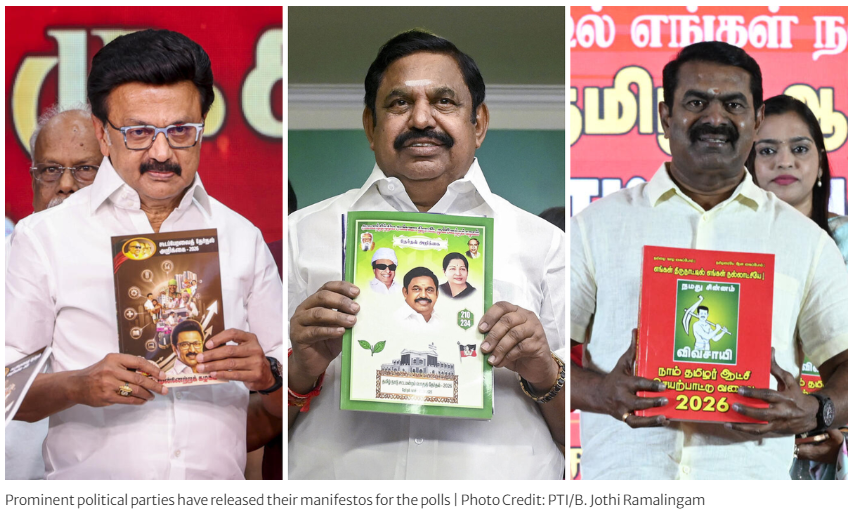
Major political parties of Tamil Nadu have released its manifestos for assembly election of 2026 including All India Anna Dravida Munnetra Kazhagam (AIADMK), Dravida Munnetra Kazhagam (DMK), Naam Tamilar Katchi (NTK) and Tamilaga Vettri Kazhagam (TVK). The election manifesto of AIADMK is 54 pages in Tamil and 45 pages in English. Similarly, DMK’s election manifesto was released only in Tamil with 98 pages and NTK released its election manifesto in Tamil with 462 pages. However, this analysis mainly focuses on key promises of AIADMK and DMK which are major forces in the race to get swing votes based on the key promises announced.
- According to some estimates the six major election promises of DMK party would cost exchequer with Rs.57311 crores per year for fulfillment of their election promises. For five year period, this freebie amount to Rs. 2,86,555 crores.
- AIADMK’s seven major election promises would cost exchequer with Rs.74,969 crore per year. For five year period, this freebie amount to Rs.3,74,845 crore.
- The TVK party which not contested a single election in the state has promised freebies for Rs.72,765 crores per year for coming to power (Source: Times of India-31.3.2026). For five year period, this freebie amount to Rs.3,63,825 crore.
It is said that the public memory of past is very short especially the polarised politics of regions and local level promises made by political parties five years ago. AIADMK has total promises of 297 and DMK has total promises of 525. Both the parties have announced several popular freebies for home care women, youth, working women, farmers, elderly people, economically disadvantages people, etc. The following table shows the major freebies announcements of both AIADMK and DMK parties:
Major Election Promises of AIADMK and DMK
Major Election Promises of AIADMK and DMK
Sl.No | AIADMK | DMK |
1 | Special assistance of Rs. 10,000/- to every family to manage the tax burden and price rise. | Rs.8,000/- coupon to all “non-Income Tax paying” homemakers to buy any electronic home appliance of their choice from the nearest stores |
2 | To reduce the household workload of homemakers, a free refrigerator (Fridge) will be provided to rice (PDS) family cardholders. | Compensation to farmers for flood disasters from Rs 25,000 to 27,000/- |
3 | To create economic equality in society, a monthly assistance of Rs. 2,000/- will be provided to all family cardholders through the Kula Vilakku Scheme. This amount will be deposited directly into the bank account of the female head of the family. | Health insurance up to Rs 10 lakh for per family
|
4 | Free bus travel scheme for men, similar to women | Income assistance increase from Rs 1000 to Rs 2000 pm for women |
5 | Through the “Amma Illam Scheme,” the government itself will purchase land and build free concrete houses for those in rural areas who do not own a house plot or a house. Similarly, for the homeless poor in urban areas, multi-story apartments will be built and provided free of cost through the “Amma Illam Scheme.” | Higher education assistance increased from Rs 1000 to 1500 pm for girls students
|
6 | Steps will be taken to implement this rural development scheme to provide up to 150 days of employment. | Old age pension increased from Rs.1200 to 2000
|
7 | Amma two-wheelers will be provided to 5 lakh working women with a subsidy of Rs. 25,000/- | Differently abled persons assistance increased Rs 1500 to 2000 Persons With Severe Disabilities will be provided Rs 2000 to 4000 |
8 | The social pension will be increased from Rs. 1,200/- to Rs. 2,000/-.to the elderly, widows, destitute unmarried women, deserted women, differently-abled persons, and transgender persons | Labour board assistance will be increased from Rs 1200 to 2000 |
9 | 3 free gas cylinders will be provided annually to the family of Rice Cardholders. | Rs 1500 for 6 months for skills development after higher education |
10 | A monthly assistance of Rs. 2,000 will be provided to unemployed graduate youth and young women registered in employment exchanges; Rs. 1,000 per month will be provided to those who have studied up to +2 and registered in employment exchanges. | Fishermen assistance Rs 8000 to Rs 12000- reduced fishing period Rs 6000 to 9000 |
11 | The relief assistance currently provided to fishermen during the fishing ban period will be increased from Rs. 8,000 to Rs. 12,000. |
|
12 | Along with the Pongal gift hamper provided every year on Thai Pongal, a cash amount of Rs. 1,000/- will be given. |
|
13 | Free electricity currently provided to handloom weavers will be increased from 300 units to 450 units, and for powerloom weavers, it will be increased from 1000 units to 1400 units. |
|
14 | Registered members of the Auto Drivers Association who do not own an auto will be provided a subsidy of Rs. 75,000/- to purchase a new auto. |
|
15 | The scheme of providing free milch cows and goats- 2 lakhs beneficiaries |
|
16 | Free laptops will be provided at the appropriate time to students studying in government and government-aided colleges. | Laptops to 35 lakhs college students |
| Loan Waivers |
|
17 | Waiver of education loans obtained from banks. |
|
18 | Loans obtained by differently-abled persons from cooperative banks will be waived. |
|
19 | Loans obtained from cooperative banks by small street vendors operating on pavements in urban areas will be waived. |
|
20 | Loans provided to Adi Dravidars for economic development through TAHDCO will be waived. |
|
21 | Steps will be taken to waive the agricultural crop loans obtained by farmers through Primary Agricultural Cooperative Credit Societies. |
|
22 | Loans obtained by differently-abled persons from cooperative banks will be waived. |
|
Both AIADMK and DMK have not uttered a word on improving institutional governance systems through governance reforms at state level, district level, city level and block/town level because it’s not a popular demand among the voters. After seeing the above promises of major parties, it shows that there is no limit to the welfare measures for regional parties. The state’s fiscal health is already stressed with mounting debts.
Both AIADMK and DMK have mentioned few common focus areas like achieving one trillion dollar economy by 2030, single window clearance system for various registrations for enterprises, education subject from concurrent list to state list, two language, etc.
AIADMK’s Vision for Economic Development
- Transform Tamil Nadu into a ‘One Trillion Dollar Economy’.
- Decentralized industrial development across Tamil Nadu, special steps will be taken specifically to boost industrial wealth in the southern districts.
- Satellite Software Park will be established with Chennai
- Pharmaceutical Parks in Chennai
- Manufacturing defense equipment and spare parts in the defense corridor in Tamil Nadu, covering areas like Coimbatore, Trichy, Salem, and Hosur.
- A “Tech City” over an area of 260 acres near Chennai for domestic and foreign financial and fintech companies to provide their services from Tamil Nadu
- To install rooftop solar panels for solar power generation in houses, a subsidy of Rs. 30,000/- for 1 kilowatt and Rs. 60,000/- for 2 kilowatts will be provided.
- Implement the Coimbatore and Madurai Metro rail projects.
DMK’s Vocabulary for Economic Development
DMK Party’s promises for the state assembly election of 2026 especially its promises for economic development, attracting investments for new industrial development, youth development, higher education, skills development, etc. are akin to what BJP party has been promoting for past many years.
For instance, the DMK Election Manifesto 2026 mentions it will promote “STEM stream focus, Civic Education, Center of Excellence, Skills development in Mechatronics, Electronic Mechanic, Advanced CNC, Robotic Welding, Electric Vehicle, Green Energy, Up-skilling, re-skilling, Formal apprenticeship, work based learning, Future skills, Skill registry, “Make In Tamil Nadu” Semiconductor, Defence, Robotics, Sunrise Sectors (Research and Development, Advanced Quality Testing labs, Additive manufacturing and metallurgical lab”, etc.
DMK also promises promotion of Global talents gateway at Chennai, Trichy, Coimbatore, Madurai, Salem, 10 Mega Plug and Play Parks, promotion of GI Tag for products, Heritage Tour, etc. The party promises for urban development with new projects like complete streets, Bio-CNG, Waste to Energy Plants, Material Recovery Facilities – MRF, Japan Kamikatsu model, Bio-mining, “Sponge City”, Global Cities, etc.
With respect to road transports and highways, the DMK promises to bring intelligent Transport Systems, Multi-Modal Logistics Parks, Multimodal Transportation Network, Industrial Corridors, buying ten thousand more buses, Integrated Bus Terminus-in towns, corporations, municipalities, etc.,
Interestingly, the most important sector like electricity department has been kept deep silence by both DMK and AIADMK because the electricity department is facing huge debt stress for several years now without proper reforms and financial prudence.
The energy sector is undergoing major shifts from conventional energy consumptions to new and renewable energy development with more and more solar, wind, domestic gas production, and hydrogen.
At present, Tamil Nadu state has total outstanding debt of Rs.10.71 lakh crore. The state debt history is interesting to note, the state’s debt was under 1 (one) lakh crore by the year 2010, it increased to about 5 lakh crore over a decade by 2021 but the debt has doubled within a period of five years from 2021-22 to 2026-27.
However, no political party is concerned about the quantum of debt mounting because they believe the economic growth will be at higher level to manage the debt which is not true because the key drivers of the economy like energy sector, mobility sector, skilling of youth, safety and security are facing multiple unsustainable challenges.
Therefore, without prudent management of public finance, the state cannot grow at faster rates for sustainable period of medium to long term. Without sustainable growth, the state cannot distribute the welfare measures of lofty promises given to people during the election time. It is ironical that a State with low poverty, high literacy rate, high life expectancy and per capita income, is still driven by political promises of rampant freebies to entice voters. It speaks volumes about the political parties as well as the voting public.
B.Chandrasekaran is a Senior Economist and Founder Chairman of the AgaPuram Policy Research Centre, Erode.
Views expressed by the author are personal and need not reflect or represent the views of the AgaPuram Policy Research Centre.