

Economic Pulse of the World’s Largest Gathering
For India, a nation with one of the oldest civilizations, the Kumbh Mela is more than just a religious festival—it is a cultural, social, and economic spectacle that has endured for millennia. Held at the Triveni Sangam in Prayagraj, Uttar Pradesh, this grand event exemplifies the deep connection between culture and economic activity. It happened during a certain celestial alignment of the Sun, Moon, Jupiter and Saturn – a rare event occurring once every 144 years.
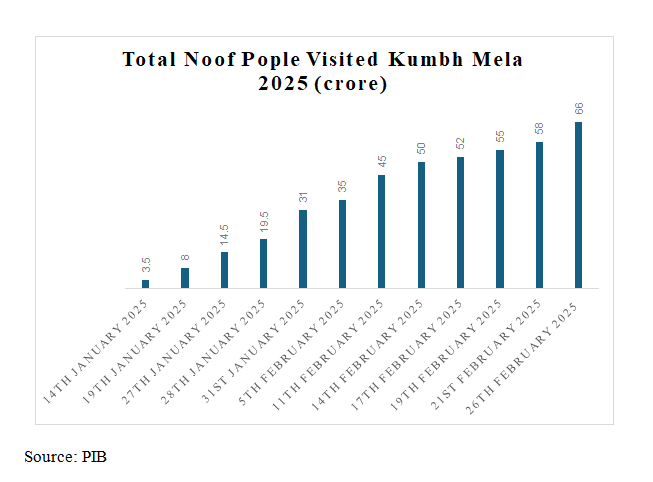
The Maha Kumbh Mela 2025, spanning 45 days from January 13 to February 26, is estimated to have drawn a humungous 66.30 crore pilgrims across India and around the world, making it one of the largest religious congregations. It is also estimated that nearly 47% of India’s population of 140 crores visited this holy site.
Prayagraj, also referred to as the “TIRTHRAJ”, has been a centre of spiritual and cultural significance for centuries. The Chinese Traveller Xuanzang, in 644 CE described Prayagraj as a region of immense natural beauty, prosperity and cultural depth attracting over 5 lakh people including the rulers and wealthy merchants. The over 2000 years old rituals of taking a holy dip in the Maha Kumbh Mela is believed to elevate spiritual thoughts. The confluence of Ganga, Yamuna and Saraswathi rivers at the Triveni Sangam adds to the sanctity of this unique location. Besides being a cultural and spiritual happening, the festival also creates immense economic activities for the region and the state, which is the crux of this piece.
Mahakumbh Nagar: A Temporary City with World-Class Facilities
To accommodate the massive influx of pilgrims, a temporary city with state-of-the-art facilities, Mahakumbh Nagar, was set up. Key infrastructure developments include:
- The renovation of 92 roads and beautification of 17 major roads, construction of 30 pontoons bridges using 3308 pontoons, erection of 800 plus multi-language signages (Hindi, English, and regional languages),
- Installation of 233 Water ATMs to provide pure drinking water 24/7, construction of 1.5 lakh mobile toilets, implementation of AI-powered crowd density monitoring system with over 350 experts at key locations, installation of 3000 plus CCTV cameras and drones, adoption of facial recognition technology, installation of water towers for fire safety,
- Employment of underwater drones capable of diving up to 100 meters to provide round the clock surveillance, usage of a dedicated app for real-time updates on crowd density, employment of 56 cyber warriors, availability of state-of-the-art Multi Disaster Response Vehicle for safety and disaster readiness, construction of temporary hospitals equipped with surgical and diagnostic facilities, and setting up of 3 temporary sewage treatment plants for river protection etc.
Logistics and Infrastructure
Managing a crowd of this magnitude involves strategic planning for transportation, accommodation, basic amenities like water, sanitation, food, and healthcare. The Swachh Bharat Mission has played a crucial role in ensuring cleanliness. The government welcomed the domestic institutions / think tanks / policy makers to make the next time bigger and better.
Many research institutions, including over 20 global institutions like Harvard, Standford, London School of Economics, Gates foundation, Kyoto University, AIIMS, IIM Ahmedabad, IIM Bangalore, IIT Kanpur, IIT Madras, JNU were invited to cover the event, right from planning to execution.
The Union Ministry of Housing and Urban Affairs has tied up with institutions of international repute to study waste management through Harvard Business School – Food and Beverage Management, operations of the event, inter-city connectivity, Multimodal transport Hubs and public transport system. Standford University – Solid Waste Management, efficiency and waste disposal. IIM – Indore – Internationals related to behaviour change, sanitation. IFC – Gates foundation – -economic impact in six districts.
The event highlighted India’s prowess in efficiently and innovatively organizing the world’s largest human gathering. The state government also achieved a Guinness World Record in Ganga Cleaning Drive and Mass Cleaning Initiative which set new benchmarks in mass sanitation and environmental efforts.
Economic Impact &Technological Innovations
The governments have always recognized the economic potential of the Kumbh Mela. In 2019, the state government spent around Rs.3,700 crore, attracting 25 crore visitors. This year, the allocation was doubled to Rs.7,500 crore. Advanced technologies such as artificial intelligence, robotics, and expert consultations have been employed to ensure smooth execution. The government’s investment of Rs.7,500 crore is expected to generate revenue of around Rs.3 lakh crore. Key innovations include:
Accommodation options ranged from Rs.2,000/- to Rs.2,00,000/- catering to diverse visitors, including the President, Prime Minister, ministers, VIPs, and international guests. The event has also boosted tourism in nearby religious sites such as Ayodhya and the Kashi Vishwanath Temple, further stimulating local economies.
The Union Ministry of AYUSH provided quality healthcare services to over 2.5 devotees at the site of the event. Over 15,953 metric tonnes of waste were removed from the Mela area to keep it clean and plastic-free.
It is estimated that the state witnessed a GST growth rate of 11% and 14% growth in the months of January and February, respectively, during Mahakumbh, generating over ₹1,000 crore increase in GST collections over the corresponding period last year. Further, the Chief Minister has stated in the Assembly that the Mela has rewarded the state economically too. He stated that a boatman family earned Rs 30 crore in 45 days with 130 boats, at Rs 23 lakh per boat & approximately Rs 52,000 a day. A definitive estimate may be expected when the official growth figures are published.
Faith to Finance
Projections suggest this surge in religious and spiritual tourism would have generated over Rs. 3.5 lakh crore in revenue (more than USD 360 Million), significantly uplifting the state’s economic landscape, benefiting everyone from small-scale vendors like cycle-borne tea sellers, bike-pool operators, boatmen, pilgrimage guides, casual laborers to local traders and corporate stakeholders.
The beneficiary sectors include food and beverages, religious offerings (such as lamps, idols, Ganga water, and incense sticks), pilgrimage guides, travel packages, ayurvedic products, and promotional merchandise. This multifaceted economic activity is projected to have boosted Uttar Pradesh’s GDP by an additional 1%, highlighting the profound impact of faith-driven commerce in propelling the state toward its goal of a One Trillion-Dollar economy, as envisioned by Chief Minister Yogi Adityanath.
Further, the Chief Economic Advisor Dr.V. Anantha Nageswaran observed that massive pilgrims visit to Maha Kumbh Mela and their spending will drive country’s GDP growth in the period of January-March, 2025 quarter 4 with 7.6% GDP which will help the country to achieve 6.5% growth during the Financial Year 2024-25 with a likely country reaching size of $4 Trillion nominal GDP.
Conclusion
The Maha Kumbh Mela is a shining example of how culture and economics intertwine to create a transformative experience. It not only strengthens India’s cultural fabric but also drives significant economic growth, showcasing the country’s ability to host the world’s largest gathering with precision and innovation. As the 2025 Maha Kumbh Mela drew to a close, it left behind a legacy of unity, faith, and economic prosperity that will be remembered for generations to come.
The author is Assistant Professor, Department of Economics, D.G. Vaishnav College, Chennai.
The author is also Research Fellow at AgaPuram Policy Research Centre.
Views expressed by the author are personal and need not reflect or represent the views of the AgaPuram Policy Research Centre.