Indian Liberals

Gold’s Price Rise – Three Perspectives

Gold’s Price Rise – Three Perspectives Gold’s Price Rise – Three Perspectives by Shanmuganathan N November 14, 2025 Indian Liberals, Public Finance, World Economy Gold’s rise over the last couple of years has been meteoric to say the least. While the media has largely overlooked the move, there have been occasional discussions on why the uncertainty surrounding Trump’s tariffs and geopolitics has led to a rise in gold prices. These narratives overlook the massive tectonic shift underneath from an economic perspective. Unless one views the events with knowledge of Austrian Economics, forecasters will likely miss the action that lies ahead. If one were to go by the US Government numbers (propaganda would be a better word – but that’s a discussion for another day), gold’s rise makes no sense – the US GDP growth is hitting nearly 4%, price inflation is on the decline, and US unemployment is near all-time lows. If this were truly the case, gold prices should not have doubled to over $4,000/oz in the last two years. However, let us return to the numbers later. Let me begin with an overview of the three prevailing perspectives on gold: Keynes’s Barbaric Relic, the Neo-Keynesians, and the Austrian Economists. I. KEYNES’S “BARBARIC RELIC” John Maynard Keynes, wrote “The General Theory of Employment, Interest and Money”, in 1936 and referred to gold as a Barbaric Relic in his thesis. In one form or another, Keynesian economics has been widely adopted and built upon over the subsequent decades, far exceeding the wildest dreams Keynes might have had. So much so that it would be (almost) appropriate to say, “We are all Keynesians now” – a quote attributed to Milton Friedman. Keynes suggested, in his work, among other things, the use of fiscal and monetary policy to manage business cycles extensively. From a Monetary policy perspective, the idea was to lower the interest rate during a recession to stimulate business activity and to increase the interest rate when price inflation is too high. How many times would we have heard this simplistic, and in fact naïve explanation, over the last few decades by Central Bankers, Economists, and commentators? From a fiscal perspective, Keynes’s suggestion was to run deficits during a recession and to use the surplus during the good times to pay down the deficits. Needless to add, once an intellectual justification (albeit a flawed one) was provided in favour of deficits, Governments never have the incentives to balance the budgets. For the record, the US Federal Government has not had a single year of budget surplus since 1971 (not an “accounting surplus”, but viewed as a decrease in the National debt).   But what has gold got to do with the above fiscal and monetary stimulus? As Greenspan wrote in Gold and Economic Freedom, “Deficit spending is simply a scheme for the hidden confiscation of wealth. Gold stands in the way of this insidious process”. Suffice it to state at this juncture that Gold limits the deficits as well as the manipulation of interest rates. The total accumulated National Debt of the US government between 1789 and 1971 was less than $400 billion. In contrast, the US has run a higher deficit every quarter for the entirety of this decade so far, with the pace of addition only increasing over time. Gold is an insurmountable barrier to even a very rudimentary implementation of Keynesian ideas of fiscal and monetary stimulus. Classifying it as a barbaric relic was a very self-serving argument for Keynes. However, in some sense, I find a commonality between Keynesians who call gold a barbaric relic and some Austrian economists who refer to Bitcoin as fool’s gold. In much the same way, the former believes gold’s price will crash in the years ahead, I think Bitcoin and other unbacked crypto prices will crash. Perhaps alongside the AI bubble bursting. With one difference in the above commonality, the key distinction between gold and bitcoin is that the latter has no non-monetary utility (i.e., Desirability in the D3C2 table below), a very fundamental requirement of qualifying as money. Barbaric Relic Summary: It would be tempting to term this as “Buffett Blindspot,” especially given the number of his followers who have used his observations on gold to classify it as a useless asset. Buffett’s views are, however, far more nuanced than that. While one doesn’t have to be Buffett to recognize that Gold has far outpaced the DJIA since Aug 1971 (a 115-fold return for gold as compared to a 55-fold return in the DJIA), I suspect nothing short of hyperinflation in the US dollar will eradicate the blind spot of this crowd II. THE NEO-KEYNESIAN ECONOMISTS A nagging piece of evidence against the Barbaric Relic Theory has been the rise in gold prices over the decades. While it could be ignored/dismissed as the proponents of Keynesian Economics do, most Neo-Keynesians find it convenient to attribute non-monetary reasons to explain away surging gold prices.  The reasons for the justification date back to 1968, when the U.S. Senate Committee on Banking and Currency held hearings on legislation to eliminate the gold cover, i.e., the legal requirement that a fractional 25% of the issued Federal Reserve Notes (i.e., the paper U.S. dollar) be backed by gold. Parallel to the Senate hearings, the House also conducted similar hearings, with the Chairman Wright Patman declaring that “the US Dollar is stronger than Gold”. The Treasury members, Federal Reserve officials, and noted Economists (including Milton Friedman) argued in favour of the bill, terming it a pro-dollar move. In reality, it was the final straw in abandoning the Gold Exchange Standard, and Nixon’s closing of the Gold Window in 1971 was a foregone conclusion after the 1968 vote in favour of removing the Gold Cover. The 1971 removal of the Gold-Dollar exchange rate was a historic move whose significance will be recognized in the years ahead. However, at the time, many officials/economists argued that it was the Bretton Woods agreement and the US Dollar that

Gold’s Price Rise – Three Perspectives Read More »

Gold @ $4,000/Oz – A Small Step for Gold; A Giant Blow to the Fiat Monetary System

Gold @ $4,000/Oz – A Small Step for Gold; A Giant Blow to the Fiat Monetary System Gold @ $4,000/Oz – A Small Step for Gold; A Giant Blow to the Fiat Monetary System by Shanmuganathan N October 13, 2025 Indian Liberals, World Economy There has been a relentless rise in gold prices over the last three years. From a bottom of around $1640 in October 2022 to $4000/oz today, Gold has delivered a 35% CAGR over the last three years. Most analysts remain oblivious of the underlying causes and attribute the move in gold prices to economic uncertainty, geopolitics, Fed rate cuts, higher price inflation, Trump’s tariffs, and other secondary factors. However, the Numero Uno factor is the return of Gold to the centre of the world’s monetary system, and these are very early days as part of that transition.  I would not be entirely surprised by an addition of “0” to the current gold price over the next 5 years. The Case for $24,000/oz in the book “RIP USD: 1971-202X …and the Way Forward” The book laid out the base case for gold prices hitting $24,000/oz by the end of the decade based on a return to “some form” of the Gold Standard by the US Fed. The $24,000/oz number was based on a 100% backing for the M0 component of the then (Q1 2024) Money Supply and is shown below. The graph (reproduced from the book) indicates that at twelve times the then price of $2000/oz, the Fed could have backed the base money (or “M0” component of the Money Supply) with its existing gold reserves. What has happened since the book was published in June 2024? The one change is the election of Trump as President of the US, effective January 2025. Unquestionably, Trump inherited a horrendous fiscal situation. However, despite his pre-election promises to balance the budget and pay down the debt, he has only exacerbated the problem. Consequently, it is time to upgrade the targets, and as explained below, $40,000/oz does indeed seem to be a reasonable projection. Funding the National Debt The growth in the National Debt for FY2025, ending September 30, has been $2.1 trillion and this is in line with the trend of the previous 5 years. However, the “Big Beautiful Bill” of Trump is expected to add at least $3 trillion per year to the National debt – a near 50% increase from the recent trends of $2 trillion annualized additions to the debt. FY2025 might well be the last year in which the annual additions to the national debt had a “2” handle. Additionally, approximately $7 trillion of the existing debt is maturing over each of the next three years. The implication is that nearly $30 trillion of US debt will need to be sold over the next three years. What will that do to the Monetary Base? The graph above indicates the external leverage that the US Government was able to get through the US Federal Reserve, financing a portion of the National debt. At its peak, between 1990 and 2007, for every $1 of the Monetary Base, the US Government was able to sell (or more correctly, borrow) up to 12 times in international markets. When the Fed monetizes the deficit, it does so by buying Treasury securities (typically long-dated) by creating new currency, which increases the Monetary base. When there is a massive expansion of the deficits, a significantly large portion of the US National Debt must be financed by the US Federal Reserve, which increases the monetary base. This causes the ratio to decline, as we witnessed during the 2008 GFC as well as during the COVID-19 pandemic. From these lows, the ratio has increased to 6+ as indeed it has today. So, merely retesting the two immediate prior lows (at around 4) of the National debt-to-M0 ratio could send Gold’s target to $40,000 in the QE tsunami that is just ahead. A strong case can be made for why this 4 is a high number, given the bankrupt nature of US finances today, and that we should expect to see much lower levels in the years ahead. Even if the ratio doesn’t drop much below 4, the National debt itself is expected to witness a steep increase in the years ahead, leading to a significantly higher monetary base. But we will leave that argument for another day. $40,000/oz is good for now. Wall Street Portfolio Allocation: A Paradigm Shift from 60/40 to 60/20/20 For decades, Wall Street’s traditional portfolio allocation rule has been 60/40, meaning 60% in stocks and 40% in bonds. Gold has been completely ignored, despite outperforming the DJIA for the past 25 years. The DJIA-Gold ratio has declined from 40+ at the start of the century to less than 12 today. In other words, excluding dividends, the DJIA, when priced in terms of gold rather than the US Dollar, has lost about 70% of its value in the last 25 years. The nominal gains are merely an illusion of monetary inflation! Morgan Stanley recently changed its allocation from 60/40 to 60/20/20, i.e., 60% stocks, 20% in bonds, and 20% in gold. Almost equally interesting is the fact that they have recommended allocating the bond portfolio to shorter-duration income securities, indicating that they expect an increase in long-term interest rates. Finally, Wall Street is waking up from its apathy towards gold and recognizing the reality ahead. Now that Wall Street has recognized gold, does it signal the end of the bull market? Not in the least. Bonds are the quintessential antithesis of gold, and Wall Street recommending equal weightage to both signifies a very queer position indeed. Bonds today, especially long-dated bonds, are still the largest bubble in history, many times the combined size of the current HB2.0 and AI bubbles. The worst part is that any attempt to reinflate the other bubbles after they burst in the form of QE will deflate the bond bubble even more. Or in other

Gold @ $4,000/Oz – A Small Step for Gold; A Giant Blow to the Fiat Monetary System Read More »

Is the Fed Setting Up Trump to be the Scapegoat?

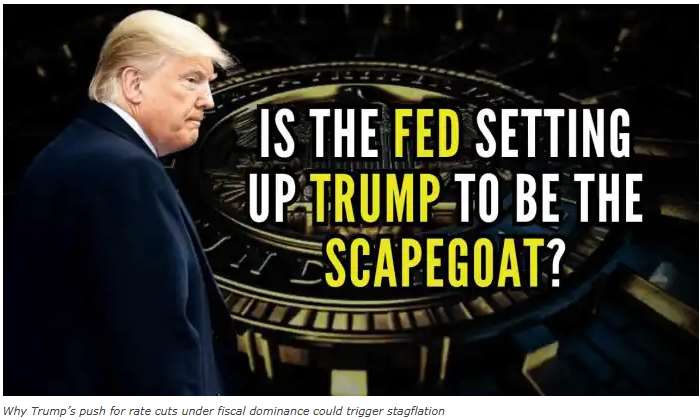
Is the Fed Setting Up Trump to be the Scapegoat? Is the Fed Setting Up Trump to be the Scapegoat? by Shanmuganathan N September 4, 2025 Indian Liberals, Public Policy, World Economy In Greek mythology, Scylla and Charybdis are two mythical sea monsters guarding a narrow strait. Navigating the sail successfully would require not getting too close to one monster while trying to avoid the other. The job of the Federal Reserve has often been compared to (mistakenly, though) the above, wherein they have to navigate the economy on its dual mandate of maximum employment and price stability. The Phillips Curve is the most standard model that depicts this supposed inverse relationship between unemployment and price inflation. Neo-Keynesian economics has broadened the interpretation of the Phillips curve from unemployment to include economic growth. So, the narrative is that if the economy is operating below potential in terms of GDP growth rate or employment, then the Federal Reserve would reduce the Fed Funds rate to stimulate the economy. If price inflation exceeds the 2% mandate, the Federal Reserve would raise the Fed Funds rate to dampen the price inflationary forces. But what happens if the growth is below par or unemployment numbers are high, AND concurrently, price inflation numbers are high? Technically, the economic scenario is called “Stagflation”. Just a year back, when Powell was quizzed about the possibilities, he quipped, “I don’t see the stag or the -flation, actually.” A short twelve months later, that is precisely the situation in front of Powell. How do the Keynesians explain “Stagflation”? They don’t; they hope that it doesn’t occur during their tenures. Paul Volcker was the last Fed Chairman who had to handle a similar situation, and even he would not want to step into the shoes of Powell today. The condition is much worse on a logarithmic scale. The solution though remains the same: dramatically hike interest rates. However, it cannot be implemented today, as it would collapse the system due to the substantial debt. But let us step back a bit and examine the entire hypothesis of this employment-price inflation tradeoff. At the outset, followers of Austrian Economics would know that this Phillips Curve and what it represents is almost as mythical as the sea monsters. It is the combination of Cantillon effects and the misrepresentation of price inflation that creates this illusion of trade-offs between employment and price stability. Examining the US price Index from the year 1800 to 1913 reveals a period of continuously falling prices. The price index was down by more than 40% by 1913, as compared to the starting year 1800. By some estimates, this fall in prices was even higher as the product basket was continuously becoming better and not even strictly comparable. Most major innovations we can think of – telephones, automobiles, airplanes, computers, mass production, modern medicine, military hardware, etc – happened during this period. The transition of the US from an erstwhile colony of the British Empire to the dominant superpower also occurred in this period. If falling prices had caused the Great Depression of 1929 to 1946, as is popularly believed, or as the Phillips curve implies, the entire 19th century (1801-1900) should have been an extended depression. Instead, what we actually witnessed was a boom of unparalleled proportions in modern history, except for what has happened in China starting in 1990 to date. How does one reconcile the Phillips Curve, and indeed, Keynesian Economics, with the above? One simply cannot. So, what does all this have to do with today? A note on the current stage, i.e., “The Oncoming Inflationary Bust,” would be in order before proceeding. The US Government has incurred unprecedented debt and liabilities since the 2008 GFC. The National debt is at $37 trillion and growing at $3+ trillion per year, while the unfunded liabilities are an additional $200+ trillion. If the Federal government were to pay its entire income towards servicing this debt (ignoring the interest part), it would take nearly 50 years to extinguish this debt. A sovereign credit rating of anything other than JUNK would be outright disregard for the fundamentals. The only way this debt is going to be resolved would be through a hyperinflationary meltdown of the economy. Barring a Milei-style presidency, that is the most probable outcome.  However, the mainstream media narrative even today is that Trump wants to lower interest rates to achieve even higher growth rates, from already what is the “best performing economy ever”. On the other hand, Powell intends to hold the rates steady to protect the purchasing power of the US Dollar. The economic truth is that both narratives are flawed. Even a 0% rate today cannot prevent a bust of the financial systems that is floating on a sea of asset bubbles – an AI bubble that dwarfs the NASDAQ 2000 bubble; a housing bubble that is far bigger than the 2008 housing bubble; and a US bond bubble that is bigger than these two bubbles combined. The bust at this point is inevitable and imminent – the timeframes would be a few months and not a few years. The current rate of 4.25% to 4.5% is way too low to contain price inflation meaningfully. The National debt is increasing at an even higher pace than before, and monetary inflation is a natural outcome, indicating that the rates are very accommodative. Why Rate Cuts are Imminent Whether Trump is aware of the above is debatable, but unquestionably, Powell understands the deep crisis the US Economy and the US Dollar face in the months ahead. The Fed even telegraphed the oncoming crisis in one of its own publications. For more than 50 months in a row, the core inflation rate – the Fed’s preferred measure – has been above the target 2%. The June 2025 number was 2.82% and under normal conditions, the US Fed would have aggressively hiked the rates. The only reason why they do not do so is “Fiscal Dominance”. What

Is the Fed Setting Up Trump to be the Scapegoat? Read More »

“China Vs US” Tariff Wars – A Repeat of “David Vs Goliath”

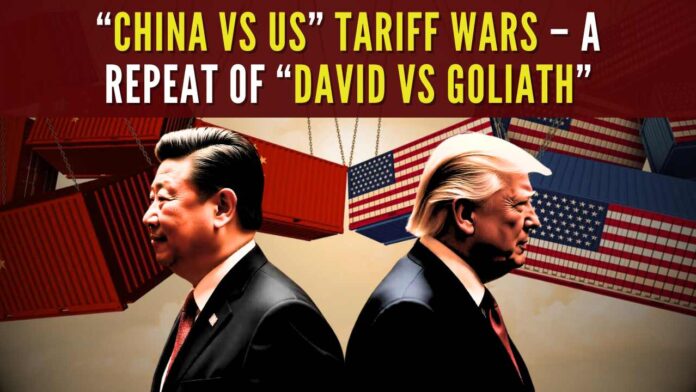
Highlights of Tamil Nadu’s First Economic Survey – 2024-25 “China Vs US” Tariff Wars – A Repeat of “David Vs Goliath” by Shanmuganathan N May 2, 2025 Indian Economy, Indian Liberals, World Economy Like the David-Goliath battle, China is poised to emerge victorious—once economic fundamentals are clear, it’s evident the real sinking ship is the US economy The world is in the middle of an escalating tariff war between US and China. The reverberations have been felt in most markets worldwide, and with no signs of a backdown by either country, the road ahead appears murky. However, that is only if one does not understand the principles of trade, currencies, and economics. As I see it, there is only one way this war will end – By China replacing the US as the dominant economic force on this planet and the US Dollar being replaced by Gold as the world’s reserve asset. The competitive advantage that China has created will stay for decades, similar to the US enjoying the dominant position during the entirety of the 20th century. Another definitive consequence of the trade wars is going to be downgrading of US treasuries from what is seen as the safest asset on the planet today to several notches below the current grade. The end game would be when the treasuries get downgraded to “near junk” status, but that is still a few years away. The decline of the US – both the economy and the Dollar – started almost very early in the 20th century, i.e., 1913, with the formation of the US Federal Reserve. But there was so much momentum and lead that the US had built up over the previous century under the classical gold standard that the decline was hardly noticeable. Similar to what Max Weber outlines in his chronicle of the decline of the Roman Empire, the culture of rugged individualism and liberty that the US was known for was conquered from within. The seeds of the precipitous part of the decline were sown much later in 1971 with the closure of the Gold Window. This ability to create “currency out of thin air” provided a carte blanche to the US Government to expand its powers within and outside the US.  This growth in government came at the expense of the private sector, which is the productive part of the economy. This restraint of gold on the government was first unshackled in 1913 with the formation of the Federal Reserve – and eventually removed entirely in 1971. Many readers may not be aware that the US Government was funded almost entirely through Tariffs on imports until 1914. Income Tax was introduced as a “soak the rich” plan to eliminate tariffs that were paid for by everybody, and instead, a small fraction of the population would pay Income Taxes. Donald Trump is right when he says Tariffs were used to fund the Government entirely at some point. But what he doesn’t know, or at least doesn’t reveal, is that Government expenses as a percentage of the economy used to be less than 2% at that point in time and not 24% as they are today. Trade – Who Benefits? With so much misinformation, it is better to start from the basics. At the outset, a trade benefits both parties involved in the transaction. When one buys a cake of soap from a retailer, it is because one prefers the soap to the currency used to purchase it. Similar is the case with the retailer who prefers your currency to the cake of soap. This is an immutable truth that trade benefits both parties involved, as otherwise, it would not happen. The trade occurs even in extreme cases of ransom/extortion because both benefit. A trade doesn’t imply that both parties benefit equally or even near equally. This is not only valid for the extortionist case above but also for legitimate transactions. For example, many customers have railed against NVIDIA for the exorbitant pricing using its “temporary” monopoly power in a specific category of chips. But in all these cases, it is indeed a voluntary transaction as NVIDIA is not forcing any company to buy its chips. Customers are buying ONLY because they are better-off with these “overpriced” chips than without. Similarly, the US imports products from China only because the citizens/residents/users benefit. The follow-on question should be obvious at this stage: If trade benefits both parties, does it stand to reason that “tariffs” hurt both parties? Of course, yes. But in very unequal ways, as I will explain in this article. Now, before getting into the details of tariffs, it’s good to correct certain misperceptions regarding the popular biblical fable of “David vs Goliath”. The usual narrative of a “victory of the underdog” is a complete misrepresentation. The truth is that Goliath never stood a remote chance of defeating David in this battle. Before explaining, think of how to defeat Bruce Lee in a one-on-one duel: the answer is simple. While Bruce Lee might come with his karate paraphernalia, you go with a loaded rifle that has a 100m range, and shoot before Bruce Lee gets anywhere near you. Another example, how can one defeat Messi? Simple again: engage him in a game of chess. The path to victory lies in making the opponent’s strengths irrelevant in the battle. Change the frame of reference. That’s what happens in David Vs Goliath as well. The latter, Goliath, is a lumbering giant figure who comes to the battle with heavy armour, shields, and swords – essentially prepared for a short-range combat. David is an expert at defending his flock of sheep from lions and wolves using his sling with devastating effect. David can very accurately aim from hundreds of yards away and that’s exactly what happens in the famed battle. Goliath lasted all of a few seconds and did not stand a chance of getting anywhere near David to use his sword. For somebody who understands military warfare, Goliath

“China Vs US” Tariff Wars – A Repeat of “David Vs Goliath” Read More »

Distinguished Indian Economists-Initiative of Azim Premji University

Distinguished Indian Economists-Initiative of Azim Premji University Distinguished Indian Economists-Initiative of Azim Premji University Mr B Chandrasekaran, Founder Chairman, AgaPuram Policy Research Centre (APRC) has contributed to the Initiative of Azim Premji University on Prof S Ambirajan’s life and works. This project explores the contributions of modern Indian economists, whose ideas and analyses have not only shaped India’s economic trajectory but also generated a deeper understanding of development and growth in the country. Chandrasekaran Balakrishnan April 17, 2025 Indian Economy, Indian Liberals Full Article is at: https://azimpremjiuniversity.edu.in/indian-economists/s-ambirajan                               https://azimpremjiuniversity.edu.in/distinguished-indian-economists

Distinguished Indian Economists-Initiative of Azim Premji University Read More »

GOLD – Is $3,000/Oz in 2025 Cheaper than $35/Oz in 1971?

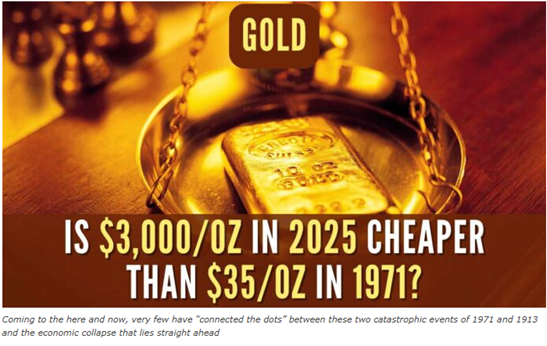
GOLD – Is $3,000/Oz in 2025 Cheaper than $35/Oz in 1971? GOLD – Is $3,000/Oz in 2025 Cheaper than $35/Oz in 1971? by Shanmuganathan N March 19, 2025 Economic Reforms, Indian Liberals, World Economy Gold prices have nearly doubled in the last 18 months from the lows of $1575/oz in September 2022. Despite the heady returns in a safe-haven asset, we are still in the early days of a super cycle that will last a decade or longer. As I explain in this article, gold prices are headed for levels most analysts cannot conceive of today.   What does “Cheaper than in 1971?” imply? During the decade starting 1971, Gold prices rose nearly 25 times to top at $850/oz by 1980. That is a 25-fold return in 10 years; a similar performance would mean a $75,000/oz price by 2035. What is the probability of that happening in the decade ahead? As I explain in this article, it’s a probable event but not a certainty. At least, not yet. What is almost certain is the target of $24,000/oz, as explained in the book “RIP USD: 1971-202X …and the Way Forward”. Undeniably, even the much lower target of $24,000/oz would still be a spectacular bull market in Gold. What caused gold prices to go up 25 times during the 1970s? DeepSeek gave several reasons: the end of the Bretton Woods System, High Inflation and Stagflation, US Dollar Weakness, Geopolitical Uncertainty, Increased Investment Demand, and Central bank policies. All of these are indeed valid proximate reasons, yet DeepSeek misses out on THE fundamental reason, i.e., Price catching up with Value. The proximate reasons are nearly irrelevant in the big picture. Without the deep discount between Price and Value as it prevailed back then, none of the proximate reasons would have increased gold prices appreciably. Gold was money from about 2800 BC until 1971. In 1980, the market priced gold at a level that would have allowed for the restoration of the Gold Standard, enabling Gold-Dollar convertibility at a fixed rate. This property of being the free market choice of money determined the value of gold in dollar terms during the 1970s; it is the same reason that is playing out today. Incidentally, when the gold window was closed in 1971, all the paper economists (i.e., the Communists, Keynesians, and the Friedmanites) unanimously predicted that the price of gold would fall well below $35/oz. It was forecasted that the price of gold would fall to $10/oz, accounting only for the industrial demand. Only to see gold prices go up 25 times in the next 10 years. The graph shows that the markets had priced gold at a level where the value of gold held at Fort Knox would have backed about 55% of the US money supply (M1). The US Federal Government could have restored the Gold-Dollar convertibility standard, with the US Dollar defined as 1/600th of an ounce of gold in 1980 / 1981. Most forms of the Gold Standard have operated with a 40% backing by bullion, and technically, the US could have transitioned to the Gold Exchange Standard that prevailed before 1971. Incidentally, the Bank of England had operated on a Gold Standard from 1717 to 1931 using a 40% reserve ratio. Ronald Reagan, a supporter of limited government and the Gold Standard, missed the last opportunity to close the Pandora’s box that Richard Nixon had opened in 1971. It is not to argue here that a 40% reserve ratio is the correct adaptation of the Gold Standard. Anything less than 100% backing is “stealth inflation”, and as long as Governments are in charge of the money supply (either through a Central Bank or with a regulatory system as was the case in the US before 1913), we are going to have the Fractional Reserve Banking system. There is no getting away from that. The point to be recognized is that even this 40% backing is vastly superior to our current unbacked paper monetary system. How high can gold prices go? – What does the above “Gold Stock – M1” graph imply for a return to the Gold Standard today? The ratio as of Q1 2025 is 0.035, and to achieve a 40% backing of the current money supply (M1), gold prices have to be about $35,000/oz. At this point, the key question is, what would the money supply be 10 years later?  That would indicate whether the current bull market in gold can rival what happened during the 1970s. Forecasting M1 Growth Two factors account for the substantive increase of M1 since 2008. Increase in National Debt: The accumulated National Debt from 1789 to the end of 2007 was a little over $9 trillion. In the subsequent 16 years, starting in January 2008, we have increased it by $27 trillion, and the National Debt today stands at $36 trillion. Increase in Federal Reserve Ownership of the National Debt: The US Fed owned less than 5% of the National Debt until 2007. However, since the 2008 GFC, the US Fed has monetized an increasingly more significant portion of the federal deficits, and this percentage increased to 10% by 2010 and 20% by 2022. The trend of the US Federal Reserve owning an increasing percentage of the National Debt will likely continue. This is for geopolitical reasons, as the US Government has practically weaponized the US Dollar since the Ukraine conflict. Most countries have their price inflation / recessionary issues to deal with. So, the tendency to either pay down the National debt (e.g., Japan) or stimulate the economy (e.g., Germany) by selling the US Dollars held would only increasingly leave the US Fed as the only buyer for the US National Debt. To project this forward, even if we assume that the M1 is set to grow at a CAGR of 10%, it will grow from the current $18.5 trillion to $48 trillion over the next 10 years. With a 40% reserve backing, gold prices would have to be well

GOLD – Is $3,000/Oz in 2025 Cheaper than $35/Oz in 1971? Read More »

Deregulation Begins at Home

Deregulation Begins at Home Deregulation Begins at Home Shanmuganathan Nagasundaram February 21, 2025 Economic Reforms, Indian Economy, Indian Liberals CEA Dr. Anantha Nageswaran eloquently distinguished between digitization and deregulation, emphasizing that digitization does not necessarily imply deregulation Our Chief Economic Advisor (CEA), Dr.Anantha Nageswaran, has made a dispassionate plea for Deregulation. He was eloquent enough to distinguish between digitization and deregulation, indicating that the former need not imply the latter. The memo to bureaucrats- Eliminate, Not Automate. Kudos indeed. If I were to add something specific on this front, it would reinforce the urgency and importance of Deregulation. The poster boy of “Free Market Economics,” Javier Milei, did not set up a committee to study Deregulation but just started on day 1 with a “Department of Deregulation”. It’s been just about a year that Milei has been in office, and they have eliminated, on average, about 5 regulations/day—and Argentina started with far fewer regulations than India has. Milei is not even a career politician. He is an Economics Professor turned President who overcame the formal collegial indoctrination on Economics by reading Rothbard and Mises. The world indeed has a role model and a roadmap to adopt. This article is about the most important Deregulation that our CEA has entirely skipped. In fact, on this aspect, we are doing the exact opposite of Deregulation and no matter what happens in all other departments/functions of the Government, unless this is fixed, nothing else will matter. I am, of course, talking about the elephant in the room, i.e. the fiscal deficit or the Deregulation equivalent in this case of running “balanced budgets”. The distortions and malinvestments caused by our deficit spending for decades (practically since 1947) has kept Indians poor. Forget Austrian Economics; even if one studies history, it will be very easy to observe that no nation has ever managed to become prosperous by continually debasing the currency. It is indeed very amusing (if not for the tragic consequences) to see a deficit-to-GDP ratio of 4%+ described as “fiscal consolidation” by economists and supposedly independent market observers. If this is the definition of consolidation, I shudder to think what expansion would look like. What is Deregulation about? Deregulation refers to removing or reducing government controls on a country’s economic functioning. It is based on the fundamental premise that market regulations offer the best protection to consumers. All transactions in the market occur ONLY because of a consensual agreement between two parties, and hence, there is no need for the Government to impose its wisdom on such issues. At a more generic level, I would look at Deregulation as the process of handing over economic control to the citizens and away from the hands of the bureaucrats and politicians.    It’s not that the markets are a utopia; it’s just that Government regulations worsen the situation. Let me take the example of a universally accepted regulation, “Minimum Wages,” and how it hurts the workers it is supposed to help. At the outset, Wages are the “price of labor”. In much the same way that we don’t want the government to determine the price of tomatoes and cars, we shouldn’t have the government determine the price of labour. The market forces of supply and demand determine wages. An employer has a choice from the labour pool of potential employees, and the employee chooses from the pool of potential employers. A “Free Market” is a voluntary transaction between two consenting parties. Nobody is forcing—neither does the employee have to work below what he thinks is his correct wage, nor does the employer have to overpay compared to what is available in the open market for that particular skill. Now, let us take the case where the “Minimum Wage” is kept above what the market would pay for that activity. Just to make the case more realistic, we will use Cognizant’s Rs.20,000 per month (that’s less than $250/month at current exchange rates) salary offer to engineering graduates. Thankfully, no minimum wage laws apply to the software industry at this point, and so despite the expected uproar of comrades, there was little traction in the market for such protests. But let us suppose that the Indian Government stipulates that the software industry’s minimum wage should be Rs.30,000 per month. How would that affect engineering graduates? Would it not improve their lives? Firstly, let us put the market size in perspective and understand the limited role that Cognizant would have in affecting the outcomes of engineering graduates. The total worldwide employee count of Cognizant is about 3.5 lakhs, and perhaps the maximum they can recruit at the entry level would be about 10% of the workforce or about 35,000. The total number of engineering graduates produced annually in India is about 15,00,000 (15 lakhs). So even if the top 10 software companies in India colluded on this Rs.20,000 pm offer, the number of potential employees it would affect is less than 25% of the workforce. Realistically, it is likely to be less than 10%. The point is that no company is large enough to affect the outcome of the industry. So, if Cognizant is offering Rs.20,000, these are indeed the prices at which these individuals can be utilized to add value for their clients in a profitable manner. So, if the government had intervened to fix the minimum wage at a higher level, then most of these graduates would have remained unemployed. Instead of recruiting X number of people at a salary of Rs.20,000, Cognizant would have recruited only a fraction at Rs.30,000 per month. But the point is not the Rs.20,000 per month lost to those unemployed due to the wage restriction. An entry-level position’s most important value to an employee is the skills they acquire in the starting years, which provide upward mobility in the industry. With their restrictions, the Government unintentionally ensures the lack of skills development that would permit a higher market wage in the future. I have used the software industry as

Deregulation Begins at Home Read More »

Indian Budgets – Missing the Forest For the Trees by Shanmuganathan N

Indian Budgets – Missing the Forest For the Trees by Shanmuganathan N Indian Budgets – Missing the Forest For the Trees by Shanmuganathan N by Shanmuganathan N February 4, 2025 Economic Reforms, Indian Economy, Indian Liberals I have consciously avoided commenting on Indian budgets despite writing extensively on various macroeconomic issues over the years. For a nation whose economic advisors have been steeped in the Keynesian witchcraft, it would have been easy to dismiss my arguments in favour of individual liberty, limited government and sound money as preposterous, or worse, anti-poor or anti-growth. What has changed now? Today, we have a Javier Milei (current Argentina President democratically elected 1 year back) demonstrating real time that ONLY Libertarianism works. I no longer have to go back to the days of the Classical Gold Standard or Patrick Henry to justify my arguments. So here it is..  On the budget passed – I can discuss income tax exemptions, the supposed ease of doing business, FDI hikes etc. Countless experts have opined but all of those discussions miss the “Forest For The Trees.”   The criticism in this article is valid for all Indian budgets without exception. In fact, there is hardly any difference whatsoever between the UPA and NDA budgets. Incidentally, Congress could have presented the same budget as Ms.Sitharaman did, and the BJP would have dismissed it as anti-growth and Inflationary (…or whatever). If I were to summarize the issue in one phrase that plagues the Indian Economic policy making since Independence, it is “Interventionism” – from a fiscal, monetary, and regulatory perspective. Starting from 1947 would be difficult for this article. However, we supposedly have adopted a reformist path since 1991 and so will start there. How has China leapfrogged India when we were both at the same level in 1991? Should we not even question the basic premise of Indian budgets and the philosophical leanings of our economic advisors? How is it that the Yuan has appreciated over the last three decades vis-à-vis the US Dollar while the Rupee has virtually plummeted with no end in sight? China has a trillion-dollar Annual trade surplus while we run trade deficits—so much for the arguments that a cheaper currency helps in promoting exports. As a country, we have buried our heads in the sands of “The General Theory of Employment, Interest, and Money.” When we should have followed Mises and Rothbard, we have chosen to borrow from Keynes and Karl Marx. In fact, from an economic policy perspective, we are closer to Marx than Keynes today. There is nothing remotely close in our budgets to describe the BJP as a “Right of Center” or “Far Right” party. Economically speaking, it’s even to the left of what the Congress was between 2005 and 2014. Right of Center used to mean something – balanced budgets, reducing regulations, minimum government etc. Today it is a political slogan. But this was the case even with Ronald Reagan so I don’t find any point in picking on current day conservatives. For the record, even Keynes never advocated running deficits during periods of growth. But this is like leaving a bottle of booze unchaperoned in a school and telling kids to drink only in an emergency. No prizes for guessing what would have happened next. Governments around the world, lead by the US, have spent like there is no tomorrow. Fiscal Deficits – The Cancer of Our Economy Firstly, we need to understand the gargantuan size of our deficits. Reporting the deficits as a % of the GDP, notwithstanding the international consensus on this, is a very disingenuous move on the part of Governments. It hides the extent to which the Governments are living beyond their means. Let’s take our FY2025 numbers: Government revenues were Rs.31 Lakh Crore, expenditures were Rs.48 Lakh Crore, and the interest component was Rs.11 Lakh Crore. I am using whole numbers because decimals are truly rounding off errors in the scheme of things. The fiscal deficit was 4.8% of the GDP as reported. I can pick several holes in the accounting principles used to report a lower deficit than is really the case, but I am skipping all of it and jumping ahead. Here is the big picture – The Total Amount available to Government after paying interest on current borrowings was Rs.20 Lakh Crore and they spent Rs.37 Lakh Crore. The Indian Government has overspent to the tune of 85% as compared to what was available to them. So, how does the Government fund the balance of Rs.17 Lakh Crore? That comes through the “Inflation Tax” (though it’s euphemistically referred to as borrowings from the Central Bank). I am simplifying here, but this is not far from the truth. At the end of the day, in essence, what doesn’t get funded directly through taxation gets indirectly funded through inflation. So the cost of Government to the citizens is not what it taxes but what it spends. The above 85% is not an exception. This would be the ballpark from 1991, perhaps even 1947. So what are the consequences of this Interventionism on the Fiscal front by the Government? There is one hallmark of Interventionism that is just plainly obvious to somebody who understands Laissez-Faire economics, but in reality, almost everybody seems to be oblivious to the fact. That Interventionism begets more Interventionism and this begets even more Interventionism becoming an infinite loop. So here are the follow-on effects. Not an exhaustive one by any standards. The deficit is met by the RBI monetization and this is “the monetary Inflation (MI)”. One of the consequences of MI is Price Inflation and this results in high interest rates. RBI then “intervenes” to lower the interest rates below what would be the “Natural Rate of interest”. This artificially low interest rate leads to the business cycle (refer “Austrian Business Cycle Theory”) or what is more commonly known as the boom-bust cycle. This leads to artificially high asset prices eventually resulting in the bursting of

Indian Budgets – Missing the Forest For the Trees by Shanmuganathan N Read More »

Nothing Wrong with Learning any language in a Diverse Country like India

Nothing Wrong with Learning any language in a Diverse Country like India Nothing Wrong with Learning any language in a Diverse Country like India Chandrasekaran Balakrishnan November 20, 2024 Indian Liberals   In the past couple of weeks, the debate on learning second or third languages other than the mother tongue erupted once again in the mainstream media focusing on Hindi or Sanskrit, although misinterpreting the long legacy issues with vested interests of dynastic regional parties, especially in Tamil Nadu. We, as a diverse society, are still far from learning and recognizing the fact that many of our founding fathers were multilingual throughout their life and work, which helped them to stretch for freedom struggles covering the length and breadth of the vast country. We need to inculcate attitude and aptitude among young minds with zeal to further develop, encourage and cultivate India’s rich and ancient languages. With the blending of technological revolution, much could be done to bridge the gaps in learning disabilities of a particular language, including Hindi and Sanskrit. One should have a little passion for learning about the beauty of a language before being judgmental of any aspect of the language or aiming to propagate the lacking in a language. The evolution of a language is a spontaneous order among the diverse community, and one man or a community alone is not responsible for its creation and nurturing of it. On 2nd September 2022, the Supreme Court declined to entertain a PIL plea for a “declaration to make Sanskrit the national language of India” the PIL was moved by a retired senior bureaucrat of Gujarat. Whether the PIL is good or bad is a different matter, the love and passion for the ancient language must be appreciated for reviving it in the larger interests of the people of India. While hearing the PIL in Supreme Court, the bench asked the pleader, “How many cities in India speak Sanskrit? Do you speak Sanskrit? Can you recite one line in Sanskrit or at least translate the prayer in your writ petition to Sanskrit.” Rather, the honorable court should have asked the right question, how and who had systematically destroyed the beautiful ancient language of India? It must be a strange situation in a vast subcontinent country like India, where Sanskrit, as the world’s ancient classic language, is in death senile for several decades, if not centuries, in modern India.   While addressing the Hindi Vivek Magazine on 16th September 2022, the eloquent Union Finance Minister shared her experience in Tamil Nadu while studying for an undergraduate degree in economics and the sad state of affairs of pity state politics against the students who are interested to learn Sanskrit of Hindi as second or third languages. She said that for decades and even now, in Tamil Nadu, the anti-Hindi agitations propagandas are played for pity politics indoctrinating young school and college students. She shared that in her college days, the students who chose either Sanskrit or Hindi as a second language would not get state government scholarships despite their names being on the merit lists of their respective universities. On 29th September 2022, while speaking at the “Karnataka Samskrit University,” on the occasion of Pre-graduate Convocation and “Sanskrit Week Celebration,” she said that in her school and college days, learning Sanskrit was not easy at all because of the “political environment in which we lived.” She further said, “and it’s not as if I lived in a foreign country. I lived in Tamil Nadu. Sanskrit was discouraged, and I think even today they discourage,”. She also said that “learning Sanskrit or learning Hindi was not encouraged at all (in Tamil Nadu)..” It would be interesting to remember the beautiful slim book titled “Sanskrit Proverbs” by Champak C Shah, published in 1923. The book is a collection of hundreds of beautiful rarest Sanskrit proverbs in English, which covers the entire human lifecycles of ups and downs, all possible situations of pleasures, pains, etc., embedded in nature, community, harmonious living, cultural ethos, and antiquities, governance, leadership, etc. Each proverb has multiple perspectives which are quite enthralling to relate to practical life in all sections of society: as an individual, family, community, and society as a whole. The following proverbs on nature, people, learning, governance, leadership qualities, etc., are quite enlightening from the generic of our ancient language. On nature, country, and people: “Mountains-are beautiful at a distance, rugged when near.” “The ocean is the course of rivers.” “Perseverance, daring, courage, wisdom, strength, and valor—where these six are, there is God.” “A fool is honored in his own house; a proprietor is honored in his own village; a king is honored in his own country; a learned man is honored everywhere.” “You should forsake a man for the sake of your family; you should forsake your family for the sake of your village; you should forsake your village for the sake of your country; you should forsake the earth for the sake of yourself.” “In sandal trees, there are serpents. In the waters with lotuses, there are also alligators. There are no unobstructed pleasures.” “The rivers themselves drink not (their) water, nor do the trees eat (their own) sweet fruit; the clouds eat not the crops—the riches of the good are (employed) for the benefit of others.” “The soul is a river, whose holy confluence is self-restraint, whose water is truth, whose bank is morality, whose waves are compassion. Here perform ablutions, 0 son of Pandu! The inward soul is not purified by water”. On India’s ancient traditions and values: “What will the Shastra do for him who has no sense of his own? What will a mirror do for him who has lost his eyes?” “There is no village—how can there be a boundary? There is no learning—how can there be fame? There is no wisdom—-how can there be salvation? There is no faith—how can there be understanding?” “The strength of men is rooted in food.” “Fasting is the best

Nothing Wrong with Learning any language in a Diverse Country like India Read More »

C.Rajagopalachari’s Venerable Thoughts on Culture

C.Rajagopalachari’s Venerable Thoughts on Culture C.Rajagopalachari’s Venerable Thoughts on Culture Chandrasekaran Balakrishnan November 20, 2024 Indian Liberals   Around the world, a human civilisation evolved over thousands of centuries ago on an undesigned pattern but their understanding of nature and by its forces paved actions shaped their desirous and quests. The laws of nature were the first instrument to form their quests to understand the reasons for human evolution and embarked on various dimensions like culture, social norms, and economic prosperity.   Since then, the human civilisation continues to make attempts to progress further on cultural values, shared social norms, and materials accumulation through trade. Whilst, we tend to track back the origins of human civilisation along with their pattern and endurance of culture, social milieus, and economic status giving importance as much as the future.  Since time immemorial, human civilisation seems to be pursued to inquire about the evolution of the cosmos, man, and desires in life. It so happens that many things that evolved around the man and his community were always quite spontaneous combining the collective behaviour of a group of people or a community. Some of the basic aspects are like desires of pleasures, languages, desire to accumulate materials, cultivate norms and values for social virtues including culture, etc. As we look back from the perspective of the twenty-first century; several centuries ago, man paved and nourished many facets of sobering endurances of culture which penetrates among the community and individual practices in daily life. The most inevitable aspect of any culture across the world is keeping oneself cleanly in body, dressed up with clothes, etc.   According to a great scholar, C.Rajagopalachari “civilisation in the true sense of the word is the development of restraint. The consensus of society, the total combined will of the people living together, seeks to curb the individual’s tendency to overdo the use of his senses. This is the difference between civilisation and barbarism.”  The word culture denotes many things to many countries. But undoubtedly, it is one of the most misused and abused words in every literature. The word culture is also most confused among people during the debate and discussions in the domain of politics, administrations, social reforms, renaissance, etc.  Chakravarti Rajagopalachari (1878-1972) was one of the greatest scholars of twentieth-century India. He was a multifaceted personality. He was a visionary and thinker. He ventured into many fields and excelled at great depth, like a legal and constitutional expert, freedom fighter and astute politician, a scholar in Indian literature, classical liberal thinker, statesman, an able administrator, scholar in Tamil literature, prolific writer, and author of hundreds of books, etc.  He was fondly called as Rajaji or C.R. by many. He was among few scholars who applied their mind into deep musing about what is culture not just in India but also of the other nations and how it evolves around the people’s social and economic progress. In the late 1950s, Rajaji was invited by Bharatiya Vidya Bhavan, Mumbai to deliver a series of lectures on Culture. The Bhavan later published the lectures in a slim book which went several editions over the years since then.  Rajaji was a principled man and hesitated to give lectures on Culture. Though he has mastered and written quite copiously on Indian literature and knew world history, philosophy, and culture. He warned, however, that “nothing can be expected from me on music, dance, the theatre or the silver screen” which were and still considered as the culture but these alone did not describe Rajaji. He spoke about the process of evolution of the culture of different nations and the case of India.   He succinctly asked “how to utilise the traditional position to the best advantage for the general community, Shall we try to enforce the obligation on the individual in respect of the entire whole and reconcile ourselves to lapses and failures? Or Shall we utilise the natural force actually prevailing in smaller circles and add it all upto make it serve the whole?”  According to Rajaji “the way of living built up by groups of human beings and transmitted from one generation to another. People each with their own long history build up separate patterns of cultures. There is much that is common, but also a great deal that is particular to each nation.” Further, “culture is not literacy or ability to play on the veena” said Rajaji, but “it has to do with general behaviour, speech, and conduct, and is different from goodness and badness of character.” Think about behaviour of political leaders in contemporary India. Also, think about behaviour of spiritual leaders across different faiths, the goodness and badness would vividly expose their character and their culture.  Unlike our confused textbooks in schools and colleges, Rajaji defines that “culture is not just character or morality. Character is the inside of a man. Culture is external rather than internal. Culture has more to do with behaviour and way of living than with character. Broadly speaking, culture is external though of course, it has much to do with character too. Because, the outside has always much to do with the inside.” In contrast, we tend to witness mostly in our public life wherein one conducts on a confused state of affairs of both character-wise and established morality of the culture.      Most of the contemporary social ills have strong negative influences of distortions of cultural values of communities in different countries including India. Partly, the government system seems to be a vital force paving towards distortions of communities’ culture which imposes restraints on an individual without force or completion. “Civilisation is not mere advance in technology and in the material aspects of life” warned Rajaji. “We should remember it is an abstract noun and indicates a state of living and not things. Mainly, civilisation connotes the curbing of wildness, barbarity, and over- indulgence of passions and appetites” observed Rajaji.  According to Rajaji “civilisation has two instruments to achieve the object of curbing the sensual instincts and preventing or deterring over-indulgence.” He explains that one instrument is the government’s enforcement of the

C.Rajagopalachari’s Venerable Thoughts on Culture Read More »