

Missing Markets for Managing Stubble Burning in Punjab and Haryana
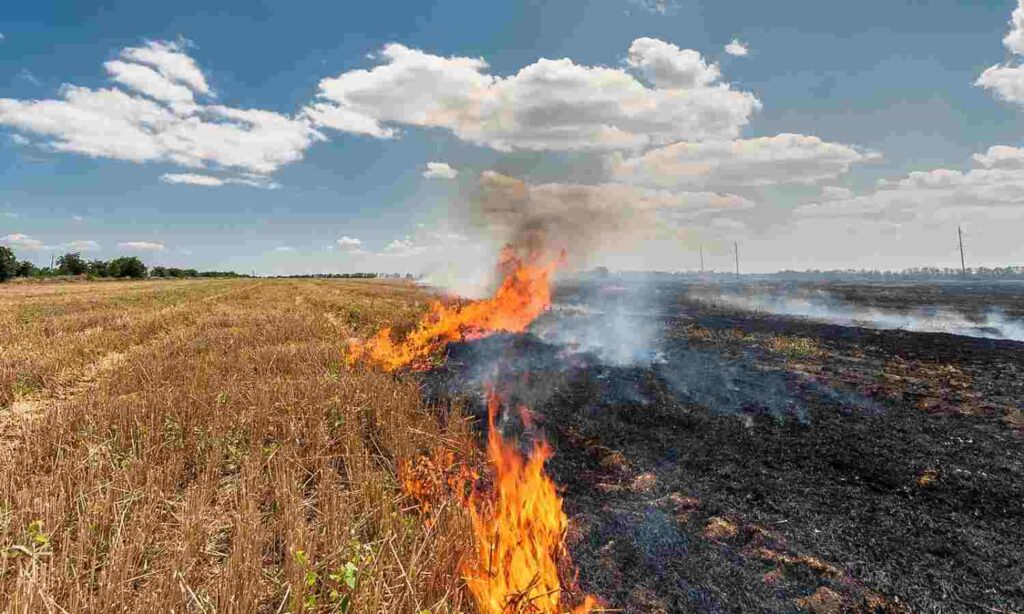
Missing Markets for Managing Stubble Burning in Punjab and Haryana Missing Markets for Managing Stubble Burning in Punjab and Haryana Naimitya Sharma June 5, 2025 Indian Economy, Public Policy, State Economies India’s quest for food security led to the development and consolidation of the rice and wheat cropping cycle in states like Punjab and Haryana. The Union government intervened in the agriculture sector to incentivise farmers with the help of Minimum Support Price (MSP) to ensure the adoption of the rice and wheat cropping cycle. Technological advancements in the form of a better variety of seeds ensured India, was able to feed its burgeoning population. Any intervention by the Government comes with associated costs over and above the direct fiscal costs. The specialisation in rice and wheat cropping pattern has led to huge environmental impacts. In Punjab, there is an acceleration of groundwater depletion due to its greater utilisation for irrigating rice crops sown in the summer months. The government intervened again with a law forcing farmers to delay the sowing of rice. As a result, the gap between rice and wheat crop was reduced significantly. With a short window available and with increased use of combine harvesters for harvesting rice, the amount of stubble or crop residue increased and the time available to manage it reduced. The past few years have witnessed a consistent presence of air pollution in the Punjab and Haryana regions because of this stubble burning. To think about this important problem, we may utilise economic ideas of negative and positive externality. Air pollution created by stubble burning is an example of a negative externality. Economic theory predicts that there will be overproduction of activities leading to negative externality since all the costs involved are not accruing to the producers. Instead, some costs are being borne by society in the form of air pollution. As economic costs do not incorporate all social costs, stubble burning continues unabated. Conversely, Stubble management is an example of a positive externality. Economic theory predicts that there will be underproduction of activities generating positive externalities. The benefits of stopping a farm fire accrue to not just the farmer concerned but also to everyone around the farm. There are external positive benefits enjoyed by society, but these are not part of the demand for the management of stubble, therefore the overall demand is less and in effect, the production of the management of stubble is less than the ideal amount. The challenge for policymakers thus, is to balance the generation of negative externality, i.e., air pollution emerging from stubble burning, and the production of positive externality, i.e., management of crop residue to ensure governance of this market failure. To reduce the production of stubble, the Government is attempting various initiatives ranging from an outright ban on burning, to incentivise farmers to produce other crops or adopt shorter-duration seeds. To promote the management of crop residue, the government is providing subsidies on equipment to manage crop residue along with promoting productive usage of crop residue by creating supply chains and demand for upcycled products. At the end of the day, we can look at the problem of overproduction of stubble and underproduction of the management of stubble as a problem of missing markets. Intervention by the Government needs to focus on finding and nurturing these missing markets through carefully designed policies. How to find the missing markets? To find these missing markets, the first step is to identify key players and processes. These include innovators, scientists, environmentalists, entrepreneurs, concerned citizens, farmers, and communities trying to find productive uses for stubble. To understand how key players are productively using stubble we need to identify, collate, and replicate successful case studies of converting stubble into productive usage. This exercise can lead to capacity building, thereby generating and nurturing the missing markets. To demonstrate this strategy, we may observe one example of productive usage of stubble. Two young people, Arpit Dhupar and Anand Bodha of Dharaksha Eco-solutions have found an interesting use for stubble. They are using bio-fabrication to convert stubble into packaging material with the help of mushrooms. Observing this process of finding productive use of stubble reveals that there are layers of phenomenon, interplaying with each other to generate this productive usage. The social phenomenon of Arpit observing his nephew painting the sky grey, Arpit’s own lived experience of surviving in Delhi, along with traveling across North India and interacting with the farming community plays an important role in this success. The second ingredient of this process is the observation of the ecological or physical phenomenon by Arpit and his team where they identify the bio-fabrication carried out by root-like structures of Mushrooms on Stubble thereby converting stubble into a sturdier product. The interplay between these two phenomena, social need and ecological possibility generates a potentially sustainable solution for the management of stubble. When the founders of Dharaksha Eco-solutions reach a famous startup pitch competition, the repeated questioning by one of the investors leads to a further interplay, this time between economic reality and ecological possibilities. After facing questions about the monetary potential of his idea, Arpit responds by suggesting that it is possible not just to make packaging material but also alternatives of timber with the help of this bio-fabrication. This interplay led to the establishment of a more financially sustainable future pathway for Dharaksha Eco-solutions. The learning from Arpit’s journey suggests that one critical ingredient of finding the missing markets is finding opportunities for upcycling stubble by identifying productive usage. Concerned individuals will become key players if they have had meaningful social exposure to these problems, along with an understanding of ecological processes that might generate solutions. Additionally, scaling and financial sustainability require interplay with economic reality and ideas. We can focus on these observations to generate more key players and processes in the system by empowering individuals with travel and research grants to develop a deep understanding of such problems. Exposing concerned individuals to ecological and environmental education to
Missing Markets for Managing Stubble Burning in Punjab and Haryana Read More »